
SAT Reading & Writing
Punctuation (Boundaries)
Much of the Standard English Conventions questions on the Reading and Writing modules of the SAT are what the College Board calls “Boundaries” (the other known as “Form, Structure, and Sense”). These are essentially questions about punctuation. This guide explains how to handle all boundaries/punctuation problems. Instead of just the blanket-term “boundaries,” we’ll break down each and every specific type of these questions, how to spot it, and the process to handle it.
Prerequisite
What counts as a complete sentence?
To use these processes, you need to be able to discern between a complete and incomplete sentence and independent and dependent clauses. If you can read a phrase and determine if it’s a complete sentence, everything else will fall into place. So what is a complete sentence, or rather, how should we think about them on the SATs? Think of them like this: a complete sentence is exactly one Independent clause + Literally any number of dependent clauses, including zero dependent clauses.
Independent clauses
An independent clause has a subject and a verb. You can usually just tell: if it sounds like it could stand on its own, or like a complete thought, it's an independent clause and therefore a complete sentence by itself. A few examples:
- The committee reached a compromise after weeks of unproductive debate.
- The engineer revised the design so that it could withstand greater pressure.
- The student who had submitted her essay late asked for additional feedback.
Dependent clauses
Dependent clauses can't stand on their own. You don't need to memorize grammar terminology; just learn to recognize these four common patterns.
Phrases that set time or place
Prepositional phrases are phrases that set time and place by starting with words like "As," "While," "In," "At," "Near," "Above," "Below," and similar words.
- In the 1950s
- While the board members debated the merits of the proposal
- Over twenty years ago
- Above the building
- Formed in 1967 to foster political and economic stability within the Asia-Pacific region
- When the manuscript was returned to the author with extensive notes and corrections
Conditional phrases
Phrases that start with words like "Because," "If," "Although," "Since."
- Since the creation of the oversight committee
- If the leverage ratio reaches a certain point
- Because these organisms are so tiny
Phrases that start with an "ing" word.
A very common pattern that's easy to spot once you're looking for it.
- …, starting with the lowest number.
- …, solidifying her position within the organization.
- …, forming a layer of sedimentary bedrock.
- …, ensuring that proteins retain their original configurations.
Interjections
A dependent clause tucked inside another clause. If you can remove the phrase and the sentence still flows, it's an interjection. They're usually found inside independent clauses, but on harder questions can appear inside a dependent clause too. They're explicitly tested with commas and dashes, and recognizing — then mentally removing — them makes many questions far easier.
- The company, though battered by years of declining profits, announced an ambitious new initiative.
- In The Book of Salt, for example, the exiled character of Bình connects to his native Saigon through the food he prepares
- The artwork, though controversial at its unveiling, has since become widely celebrated.
- The invention, which transformed communication across continents, changed history.
Common sentence-structure patterns
These are the shapes you'll see over and over on the SAT. Getting fast at spotting them makes every boundary question easier.
Independent clause only
- The engineer revised the design so that it could withstand greater pressure.
- Beatrix Potter is perhaps best known for writing and illustrating children's books such as The Tale of Peter Rabbit (1902).
- The orchestra performed a piece that blended classical structure with modern dissonance.
Dependent, Independent
- In 1933, the Twentieth Amendment to the US Constitution was ratified.
- In her poetry collection Thomas and Beulah, Rita Dove interweaves the titular characters' personal stories with broader historical narratives.
- In a study of the cognitive abilities of white-faced capuchin monkeys (Cebus imitator), researchers neglected to control for the physical difficulty of the tasks they used to evaluate the monkeys.
Independent, Dependent
- The intense pressure found in the deep ocean can affect the structure of proteins in fish's cells, distorting the proteins' shape.
- The cognitive abilities of monkeys given problems requiring little dexterity were judged by the same criteria as were those of monkeys given physically demanding problems, such as unscrewing a bottle and inserting a straw.
Dependent, Independent, Dependent
- In the 1950s, a man named Joseph McVicker was struggling to keep his business afloat when his sister-in-law Kay Zufall advised him to repurpose the company's product — a nontoxic, clay-like substance for removing soot from wallpaper — as a modeling putty for kids.
- Compiled in the late 1500s largely through the efforts of Indigenous scribes, Cantares Mexicanos is the most important collection of poetry in Classical Nahuatl, the principal language of the Aztec Empire.
The core rule
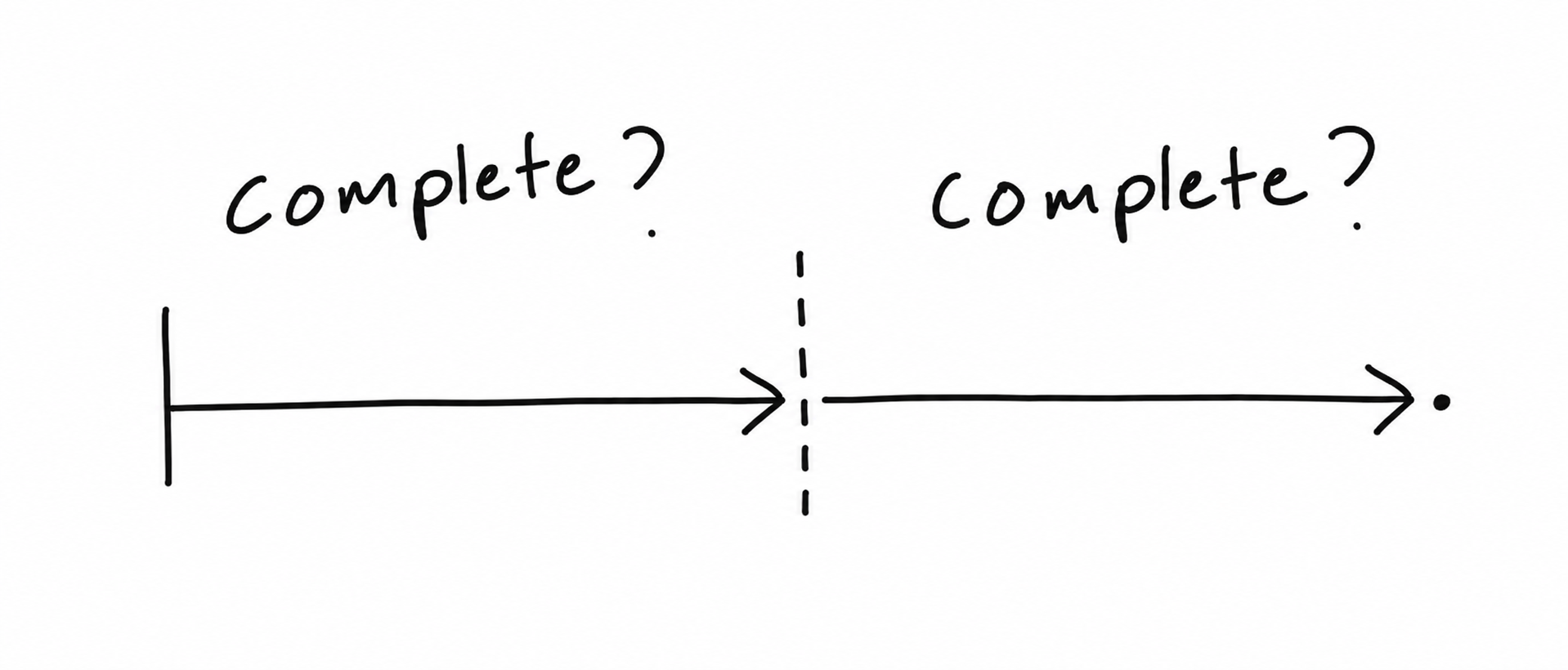
"Complete|Complete"
These three types of punctuation marks require complete sentences before them AND after them: periods, semicolons, and comma+FANBOYS (",and" ",but"). Not just a comma, and not just a FANBOYS, but a comma right before a FANBOYS together forms one punctuation mark, equal to a period and semicolon.
So, whenever you're testing one of these three, read up to the point and check if it's a complete sentence. If it's not, then it's incorrect. Then read from that point to the end of the sentence and do the same check. Let's work through some examples.
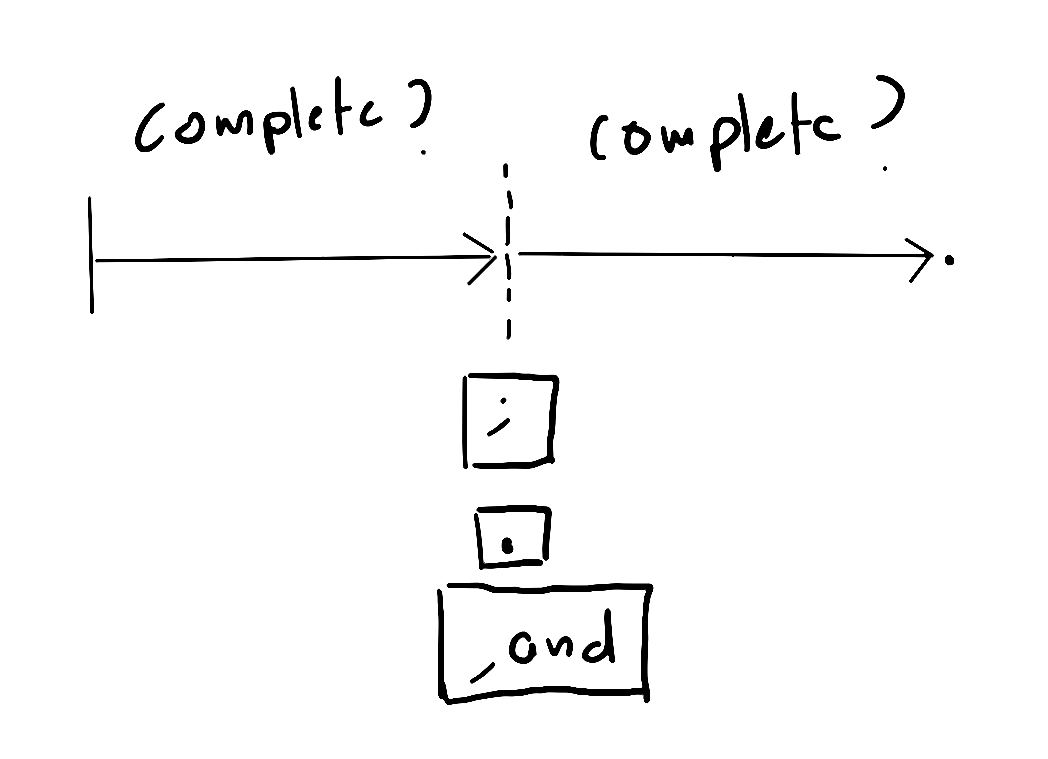
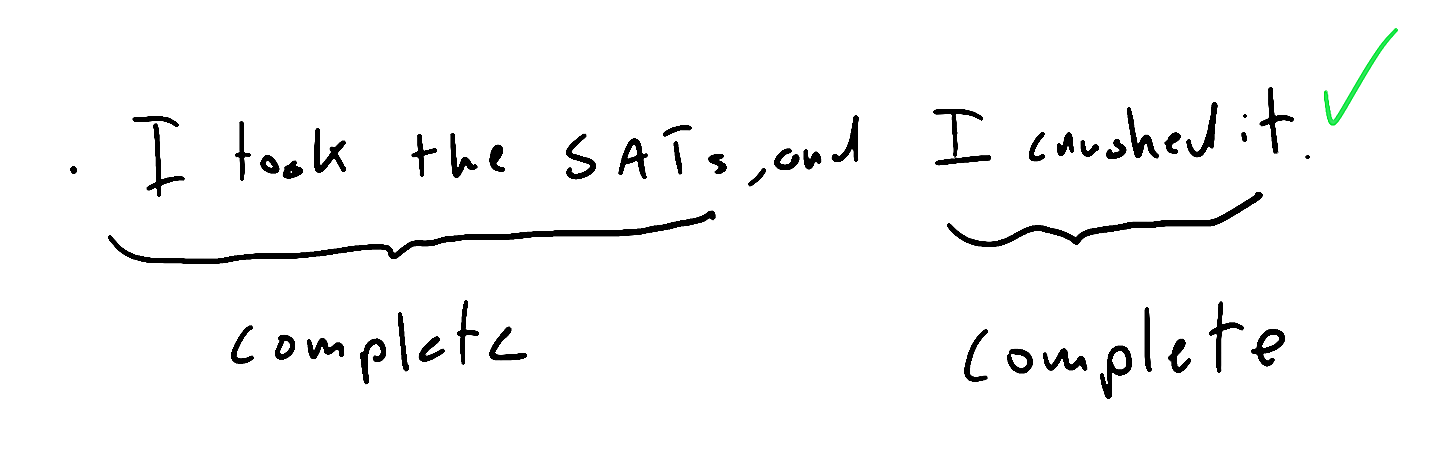
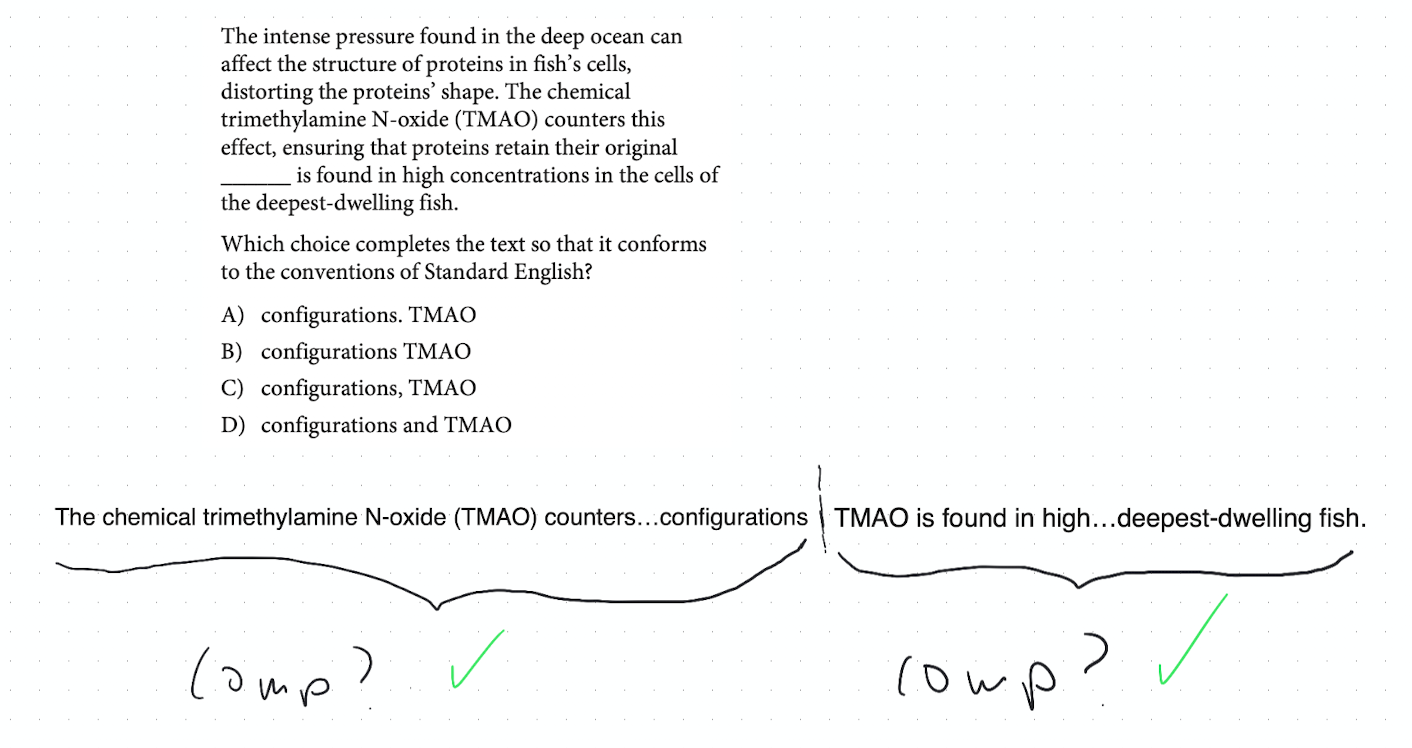
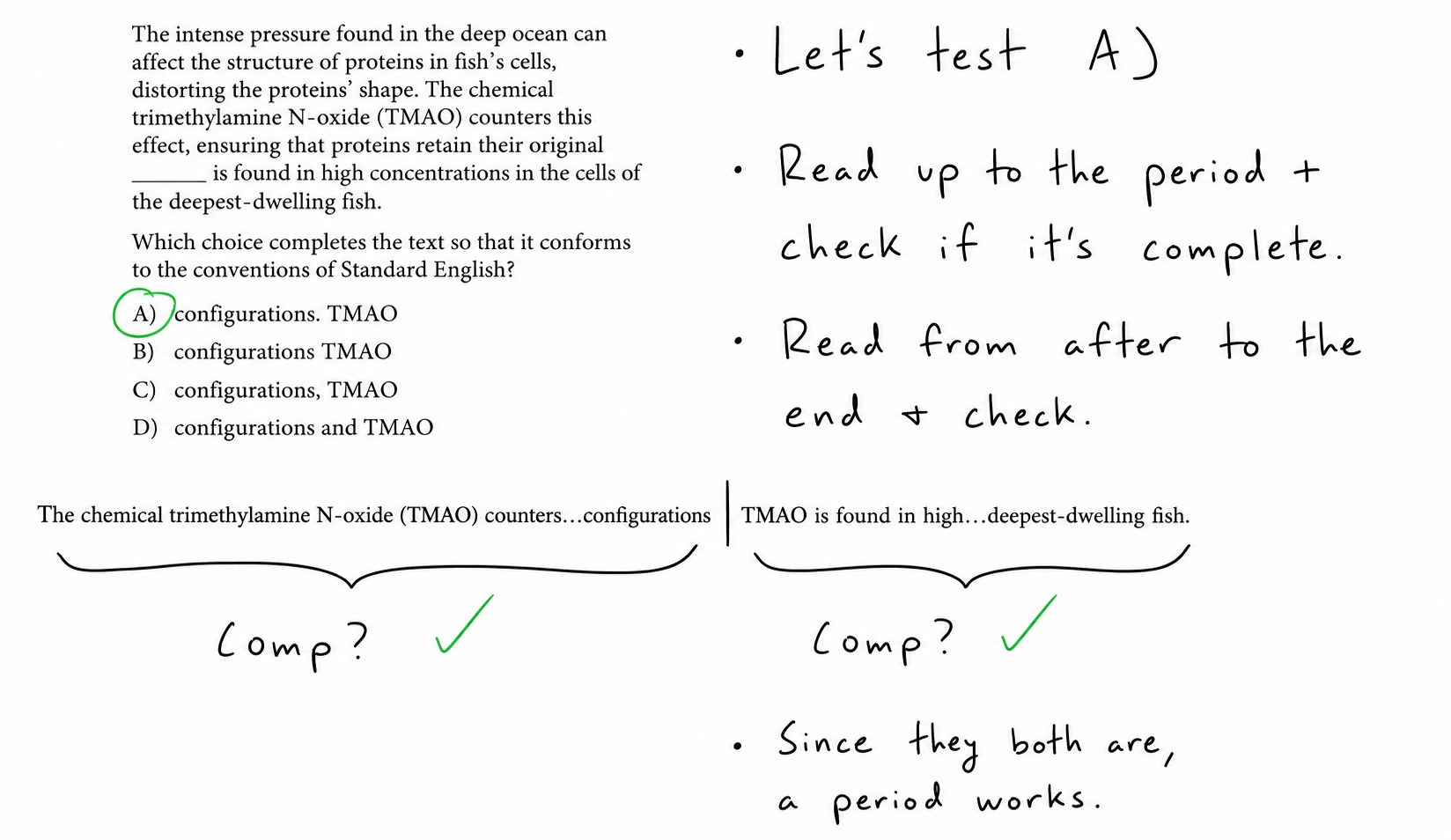
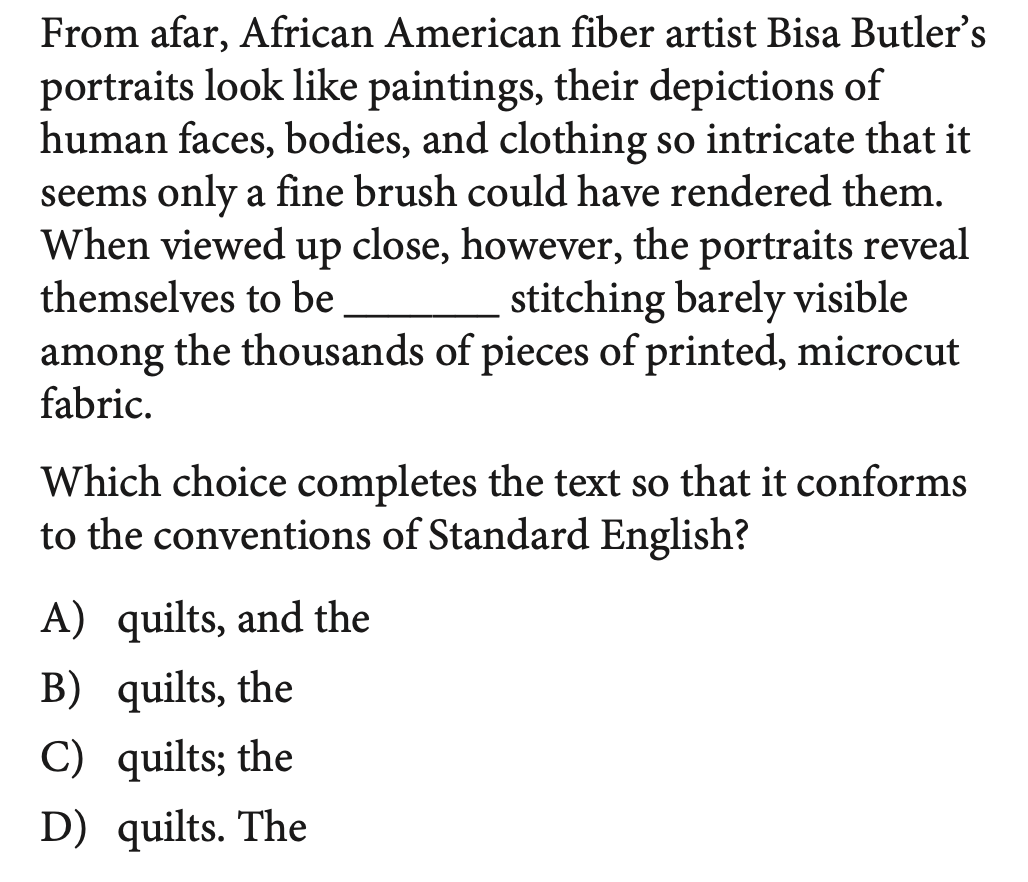
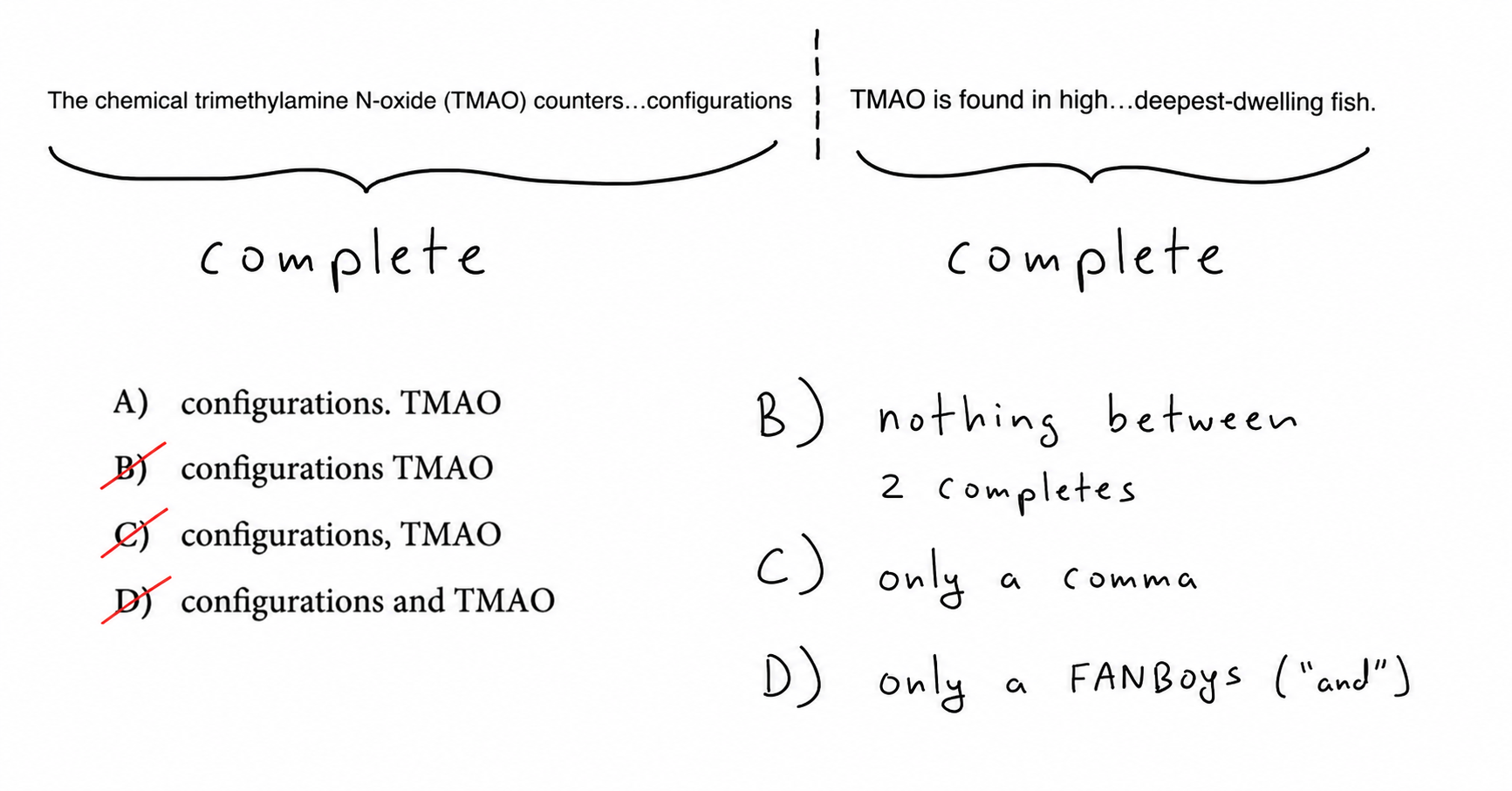
Let's test the period in answer choice A. We read up to the period to see if it's complete, which it is. Read from after the period to the end of the sentence to see if that's complete, which it is. Therefore A works, it's the correct answer.
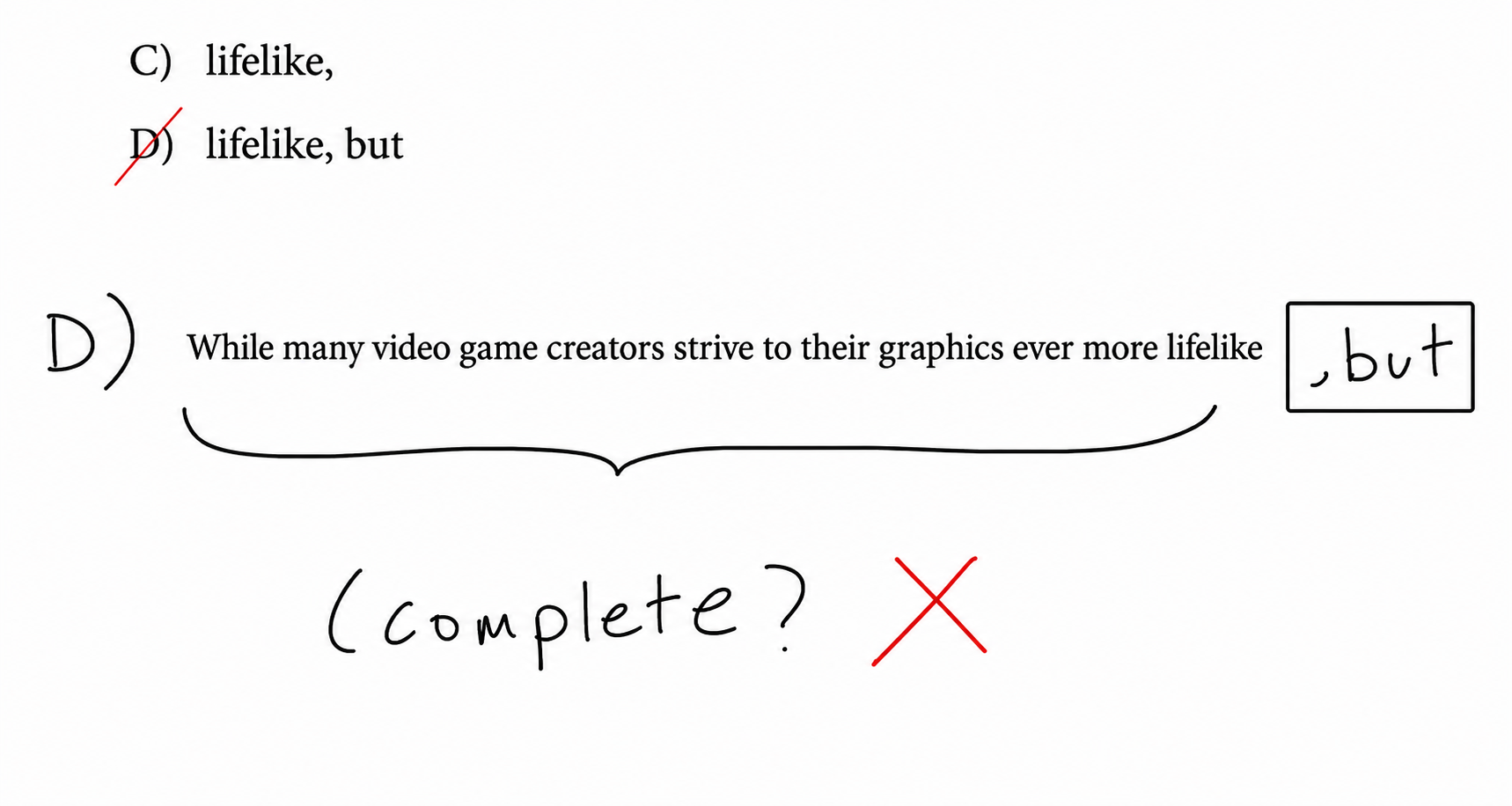
Here we see a comma+FANBOYS (",but") in answer choice D. Read from the beginning of the sentence up to the ",but". We see right away that it's not a complete sentence so D is out, since a comma+FANBOYS requires a complete sentence before and after.
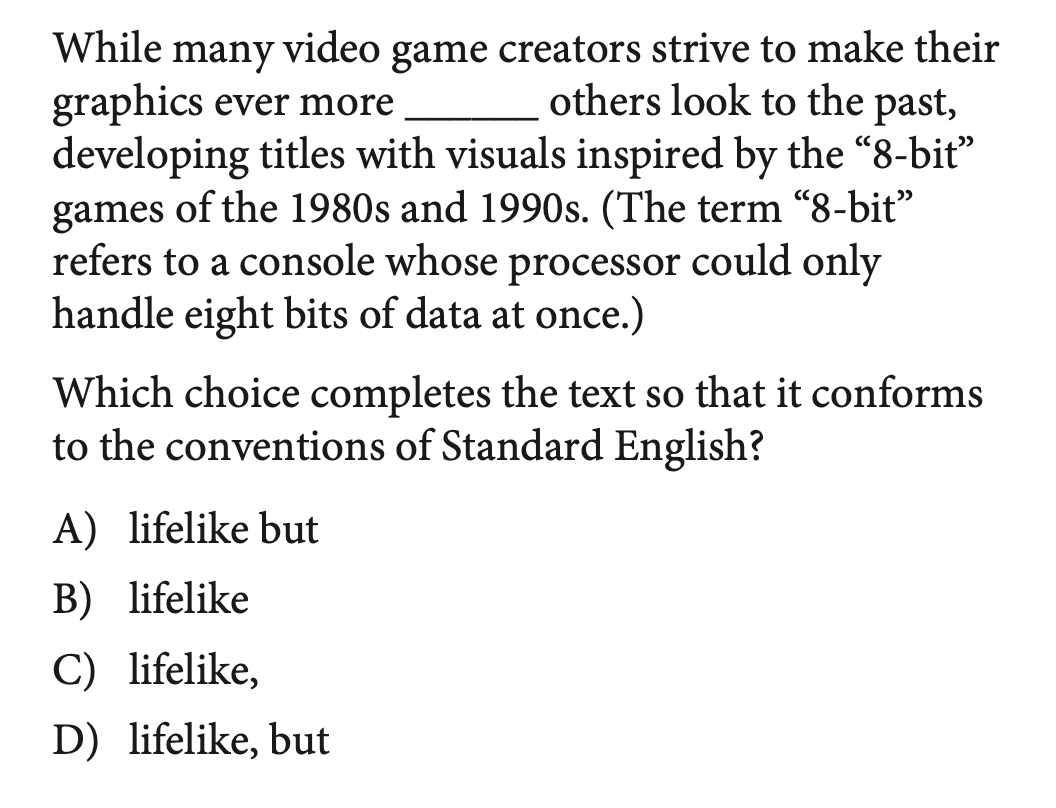
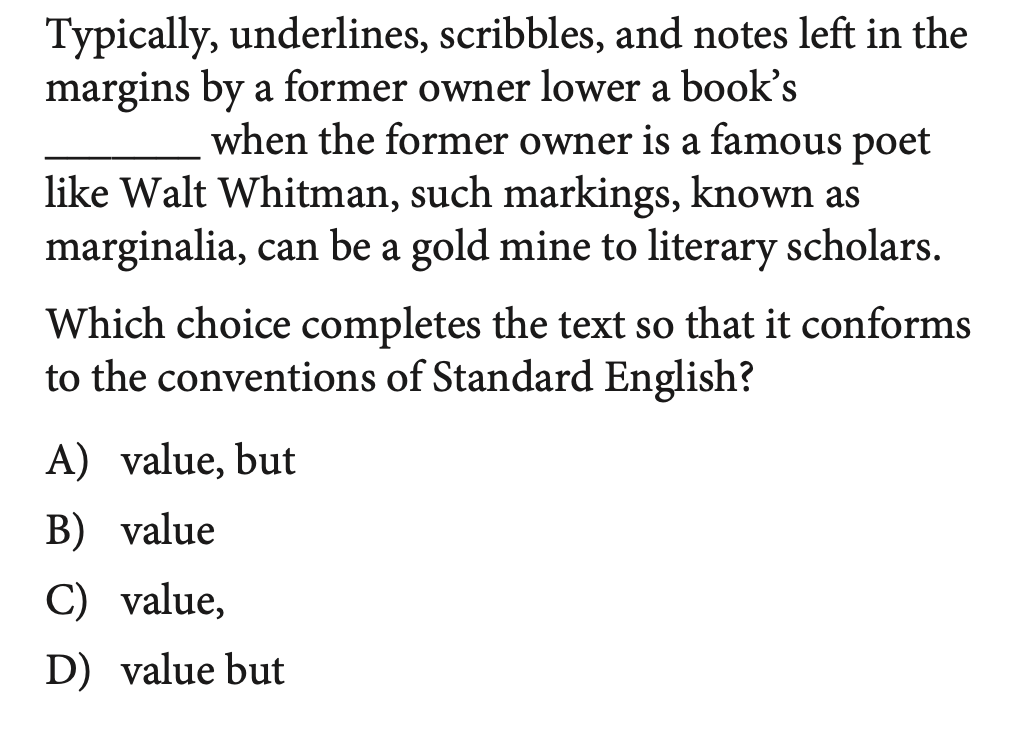
Here's an example when a comma+FANBOYS is correct, answer choice A.
Here's an example where we see that three answer choices contain one of the three "complete|complete" punctuations. We can see that no other words are changed among those three answers, meaning, logically, none of them can be correct. Indeed, if we were to test the phrase after, starting with "the stitching…", we'd see that it does not create a complete sentence.
What to avoid
Run-ons
What they are. Run-ons are where you have two complete sentences connected by only a comma, only a FANBOYS, or by nothing.
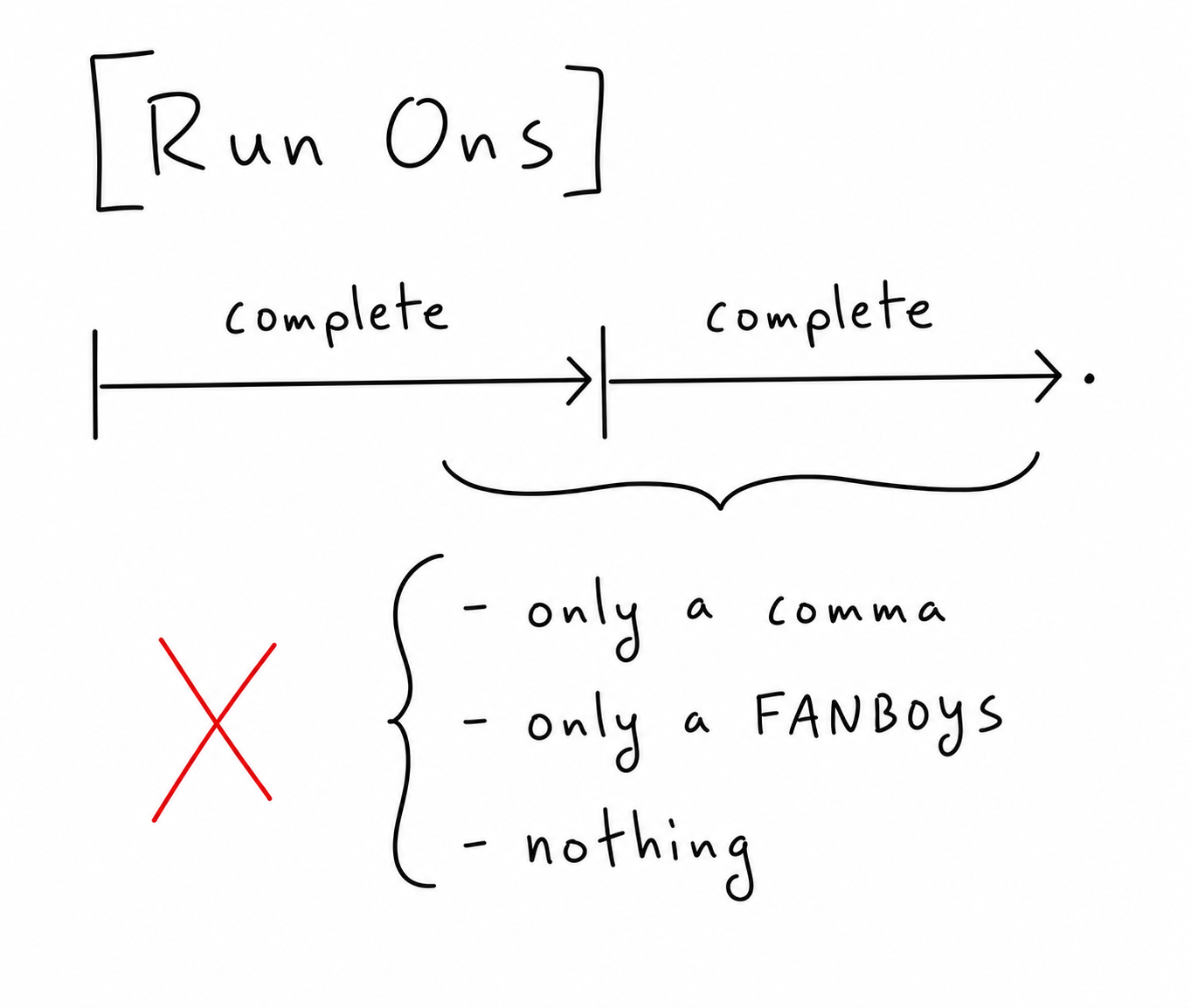
On the SAT, they're testing almost always as incorrect answers when you see that there are answers with periods, semicolons, comma+FANBOYS, or colons (which we'll talk about soon).
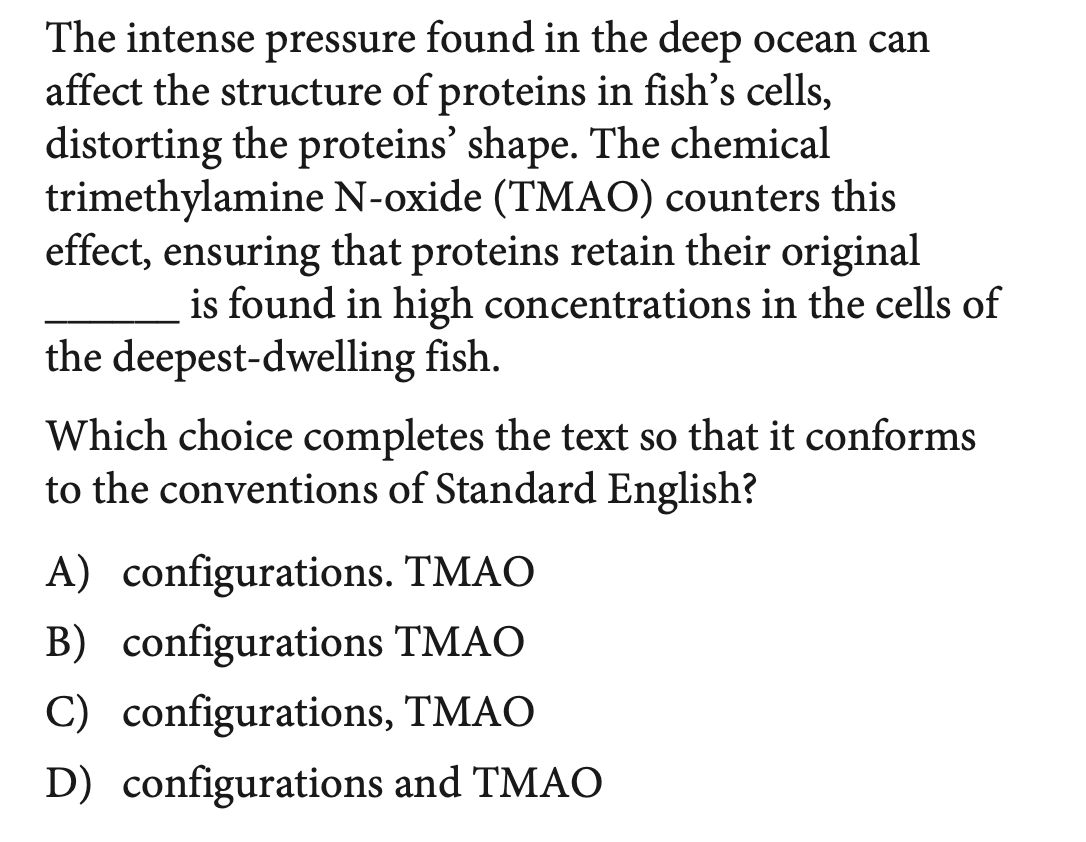
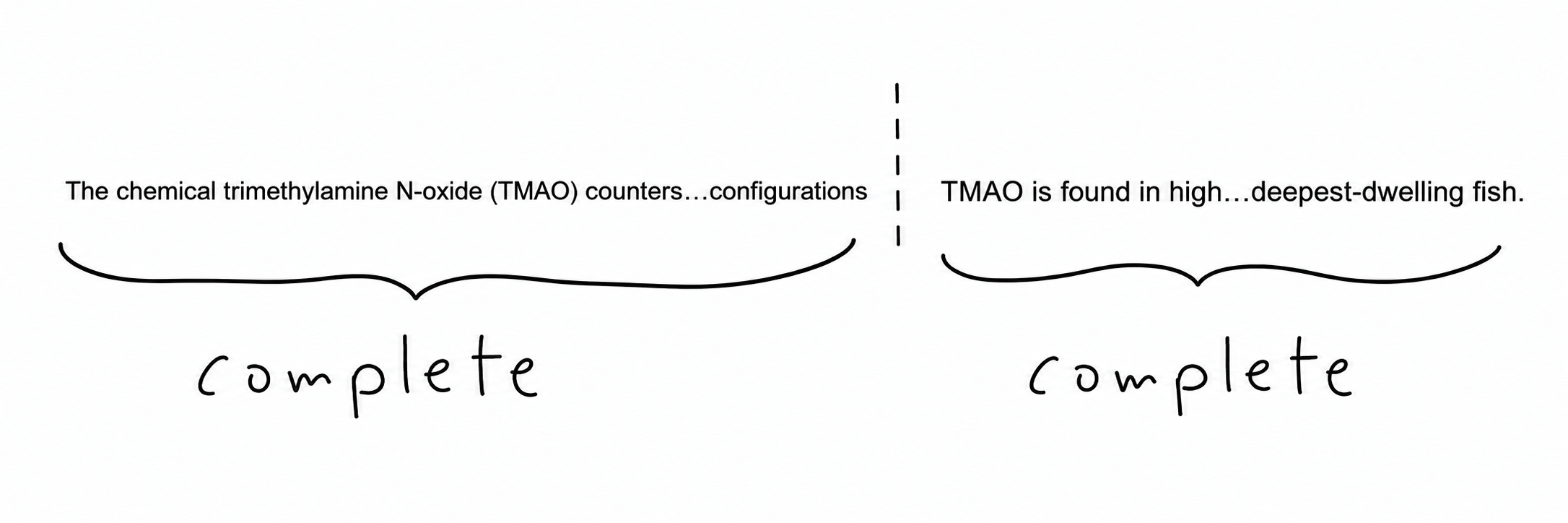
Let's revisit this problem. 2, 1, 22. We already saw that there were two complete sentences. One up to the word "configurations." and another from "TMAO" to the period. B separates them with nothing, C with only a comma, and D with only a FANBOYS ("and").
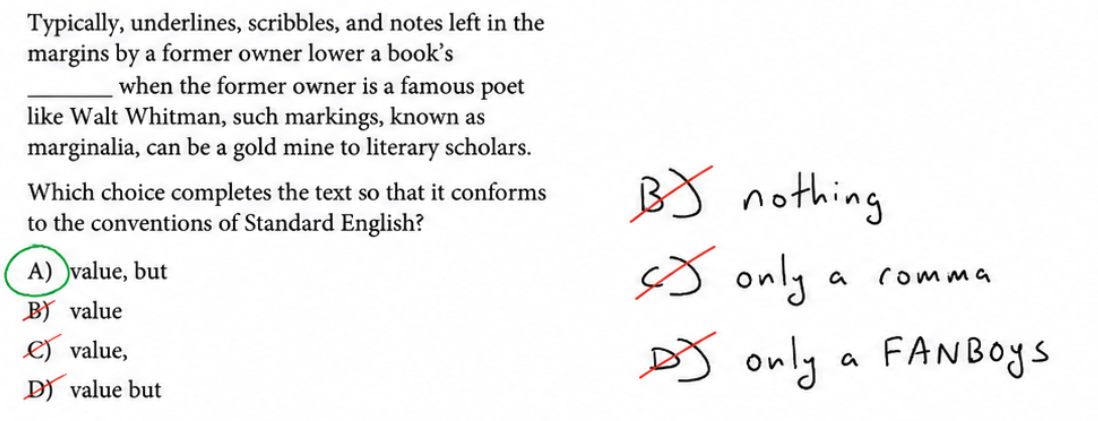
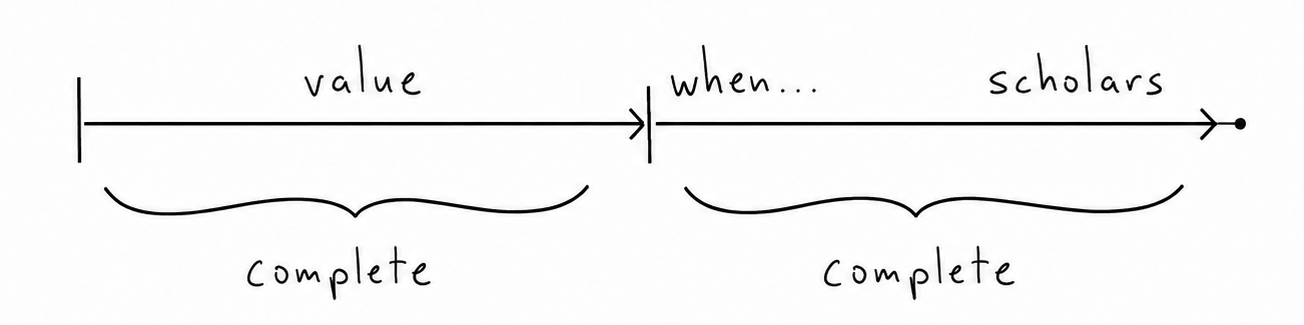
We see two completes, up to "value" and from "when"
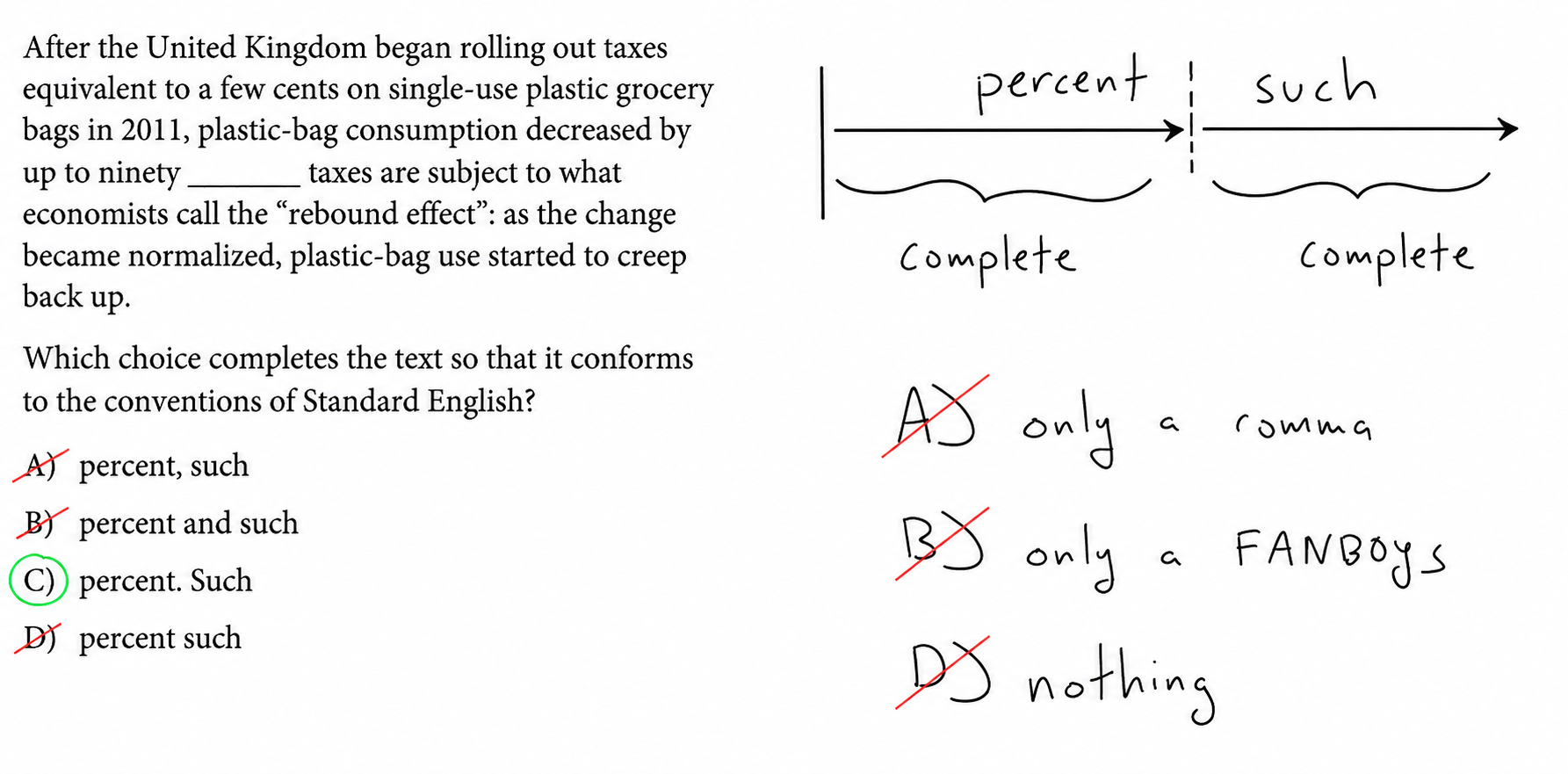
Again, two completes, up to "percents" and from "such"
A different pattern
Colons
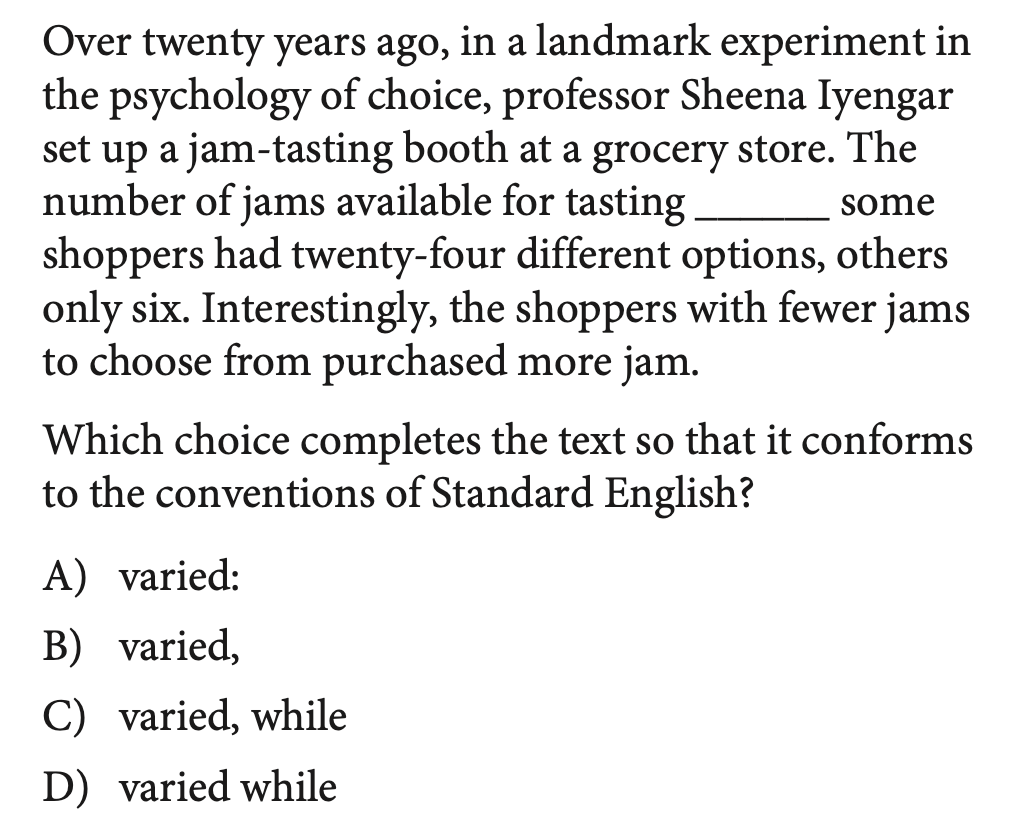
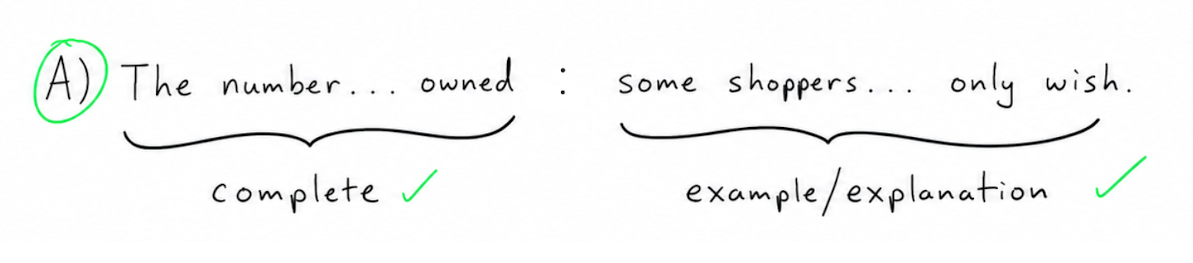
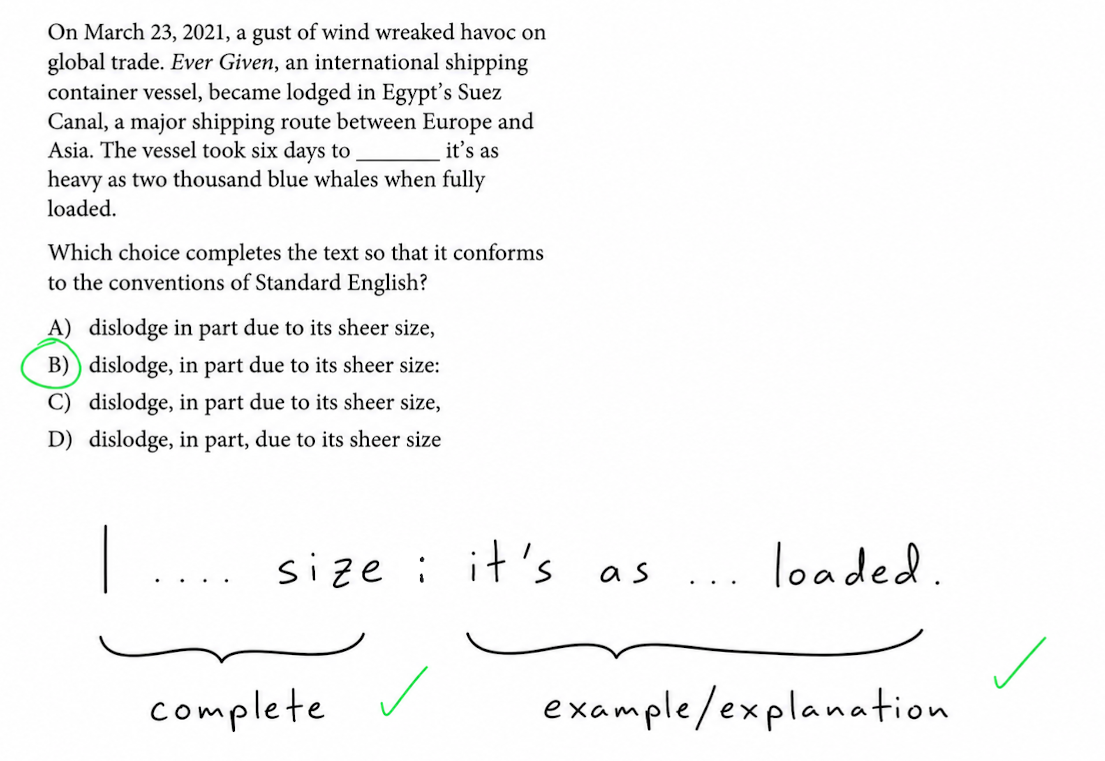
The rule for the SATs. Colons can be used in many different ways, but on the SATs, it goes like this: you MUST have a complete up to the colon, but what comes after just has to be an example or explanation of what came before it. It can be complete or incomplete. So notice it can have two completes but doesn't have to. Just make sure they're two different statements before and after.
Let's test answer choice A. From "The number" to "varied" is complete, so we're good so far. Then what follows "some shoppers" to the end of the sentence is an explanation of the first phrase. A it is.
Running the same test, we see that B is correct.
The two comma rules
Commas
Commas are mostly tested in two different ways: to bookend interjections and to separate independent and dependent clauses. Interjections have to be surrounded by two commas, or as we'll see, with dashes. However, it's much more common to see this done with commas.
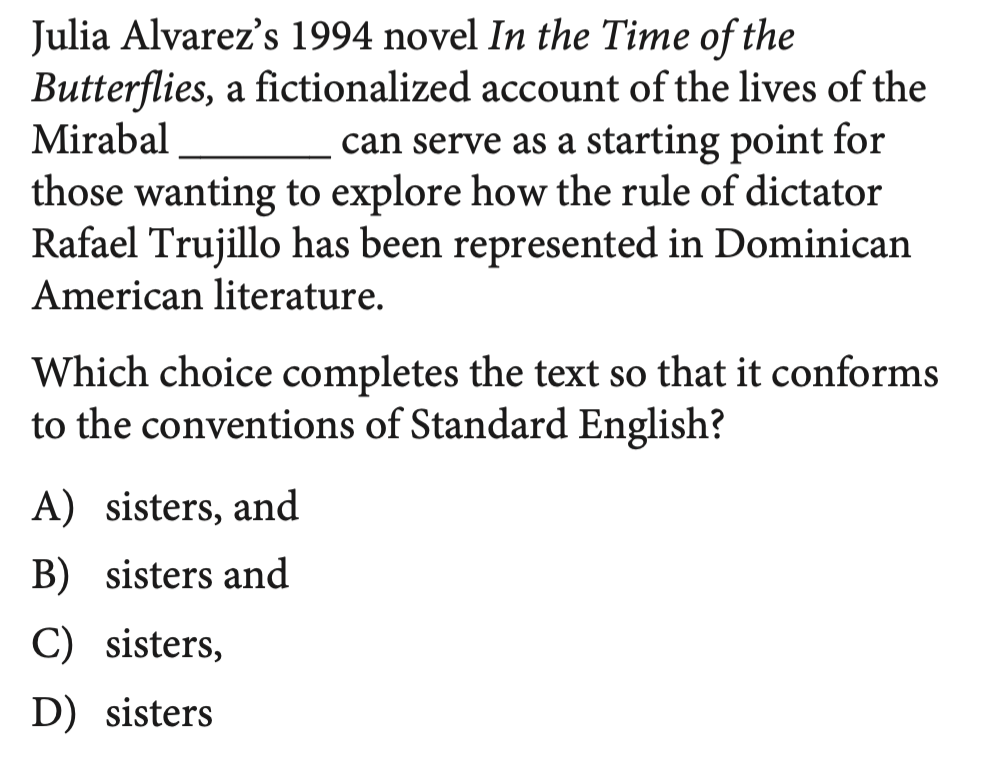
The other test of commas follows this rule: on the SATs we ALWAYS separate independent and dependent clauses.
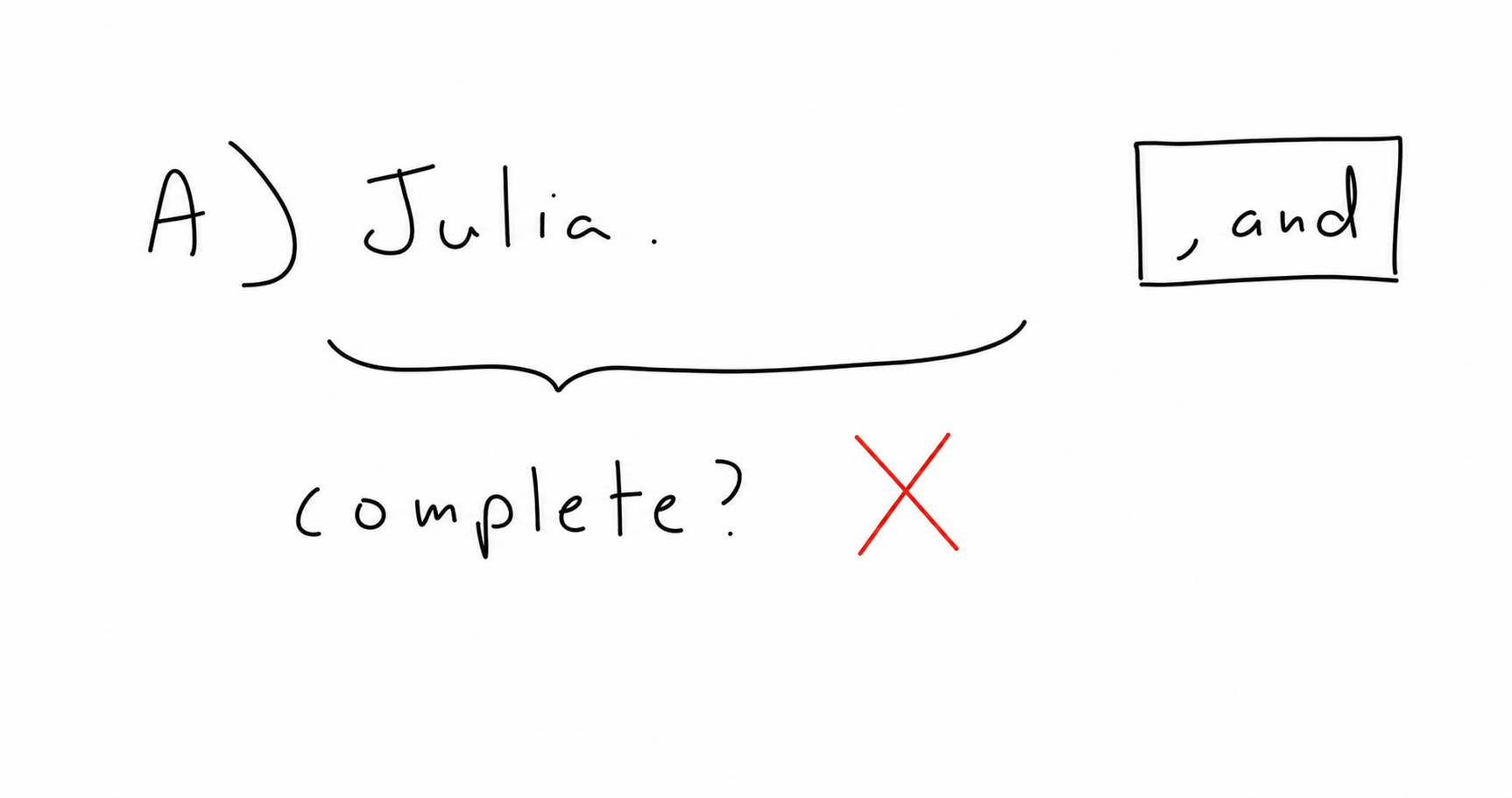
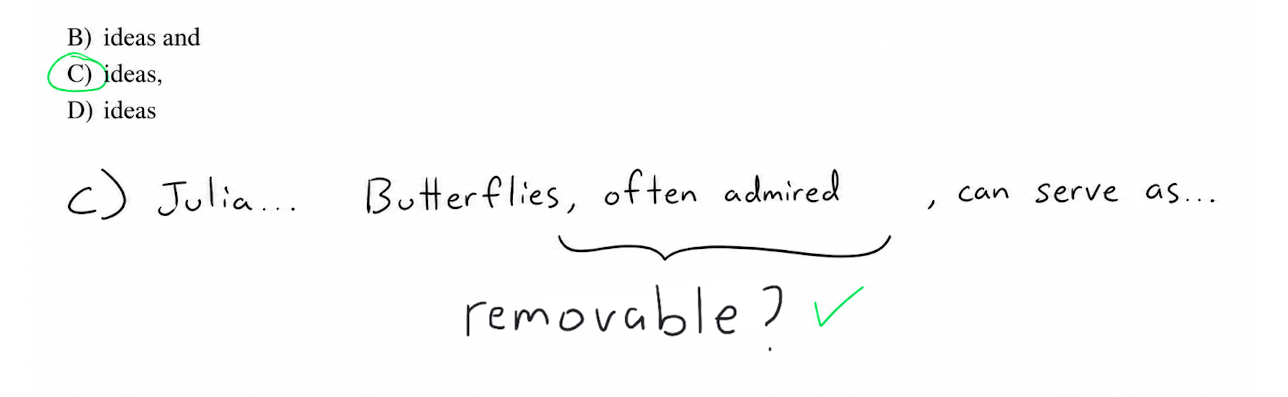
Checkout this question. You notice that A) has ",and" but does not have a complete before it. That's out. Then let's check the answer with a comma. I read the sentence without the phrase now located inside two commas "a fictionalized … sisters," and see that the sentence flows: Julia Alvarez's 1994 novel In the Time of the Butterflies can serve as a starting point for… It flows. Choice C is correct.
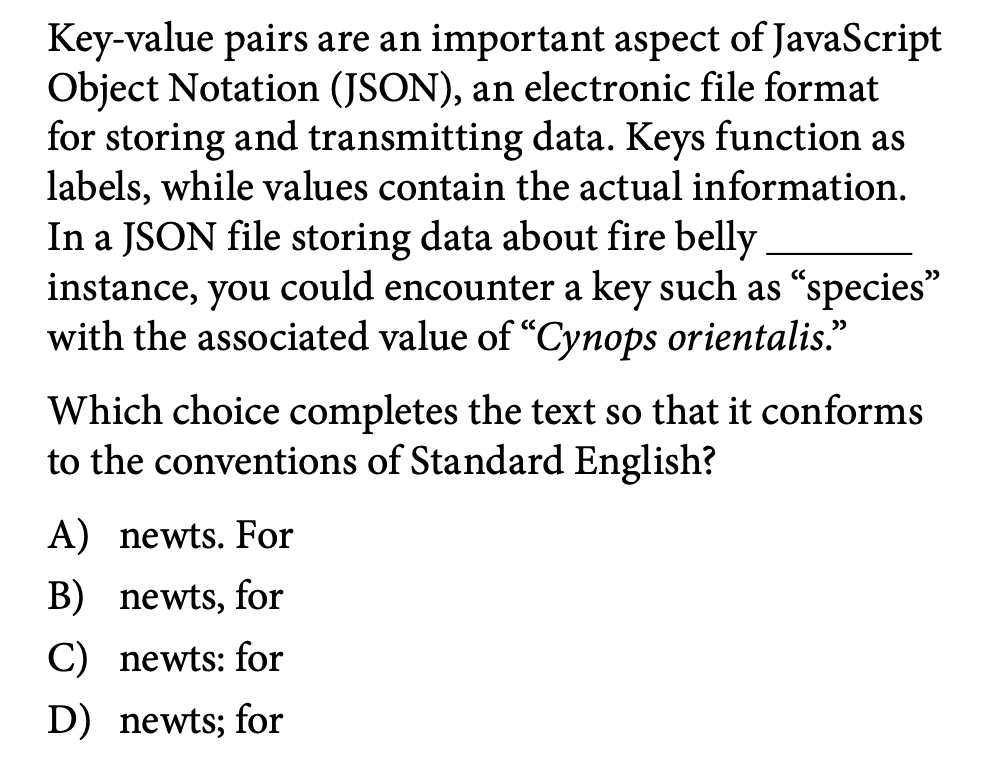
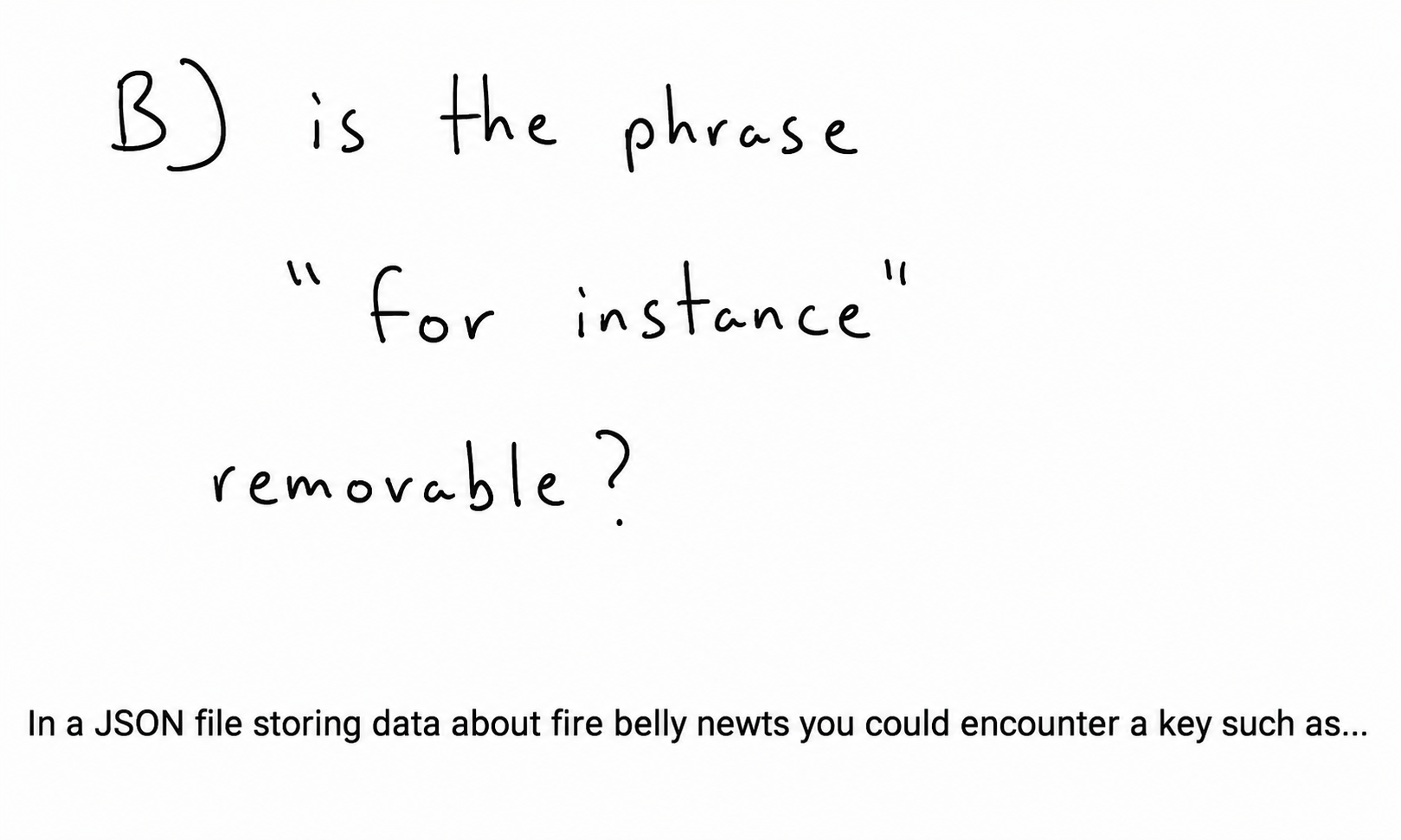
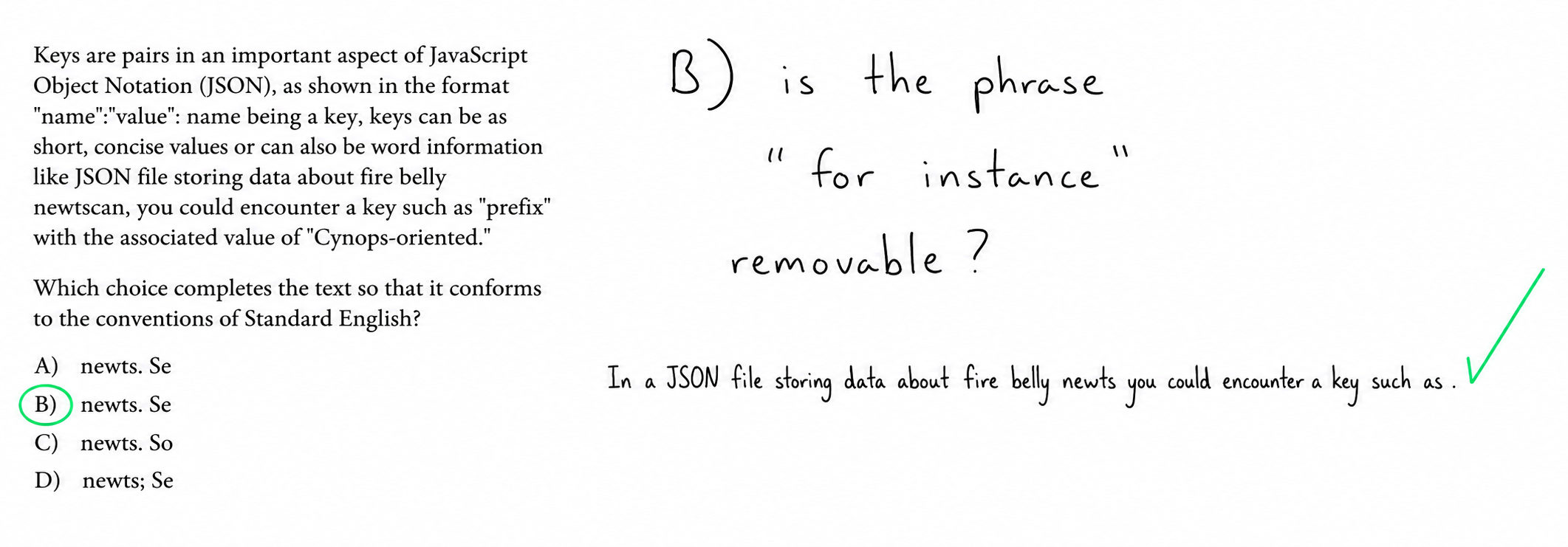
Another quick example. B) Since we can remove the phrase "for instance" choice B is correct. Notice none of the others have complete sentences up to the word "newts", which they all require, so we can eliminate them for that reason.
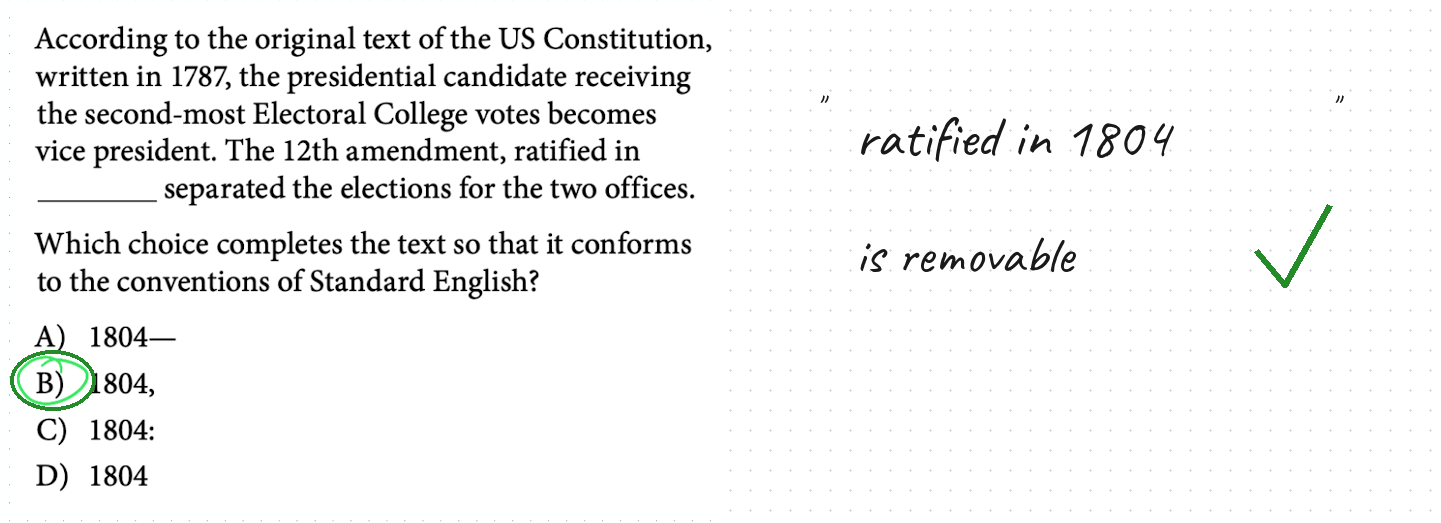
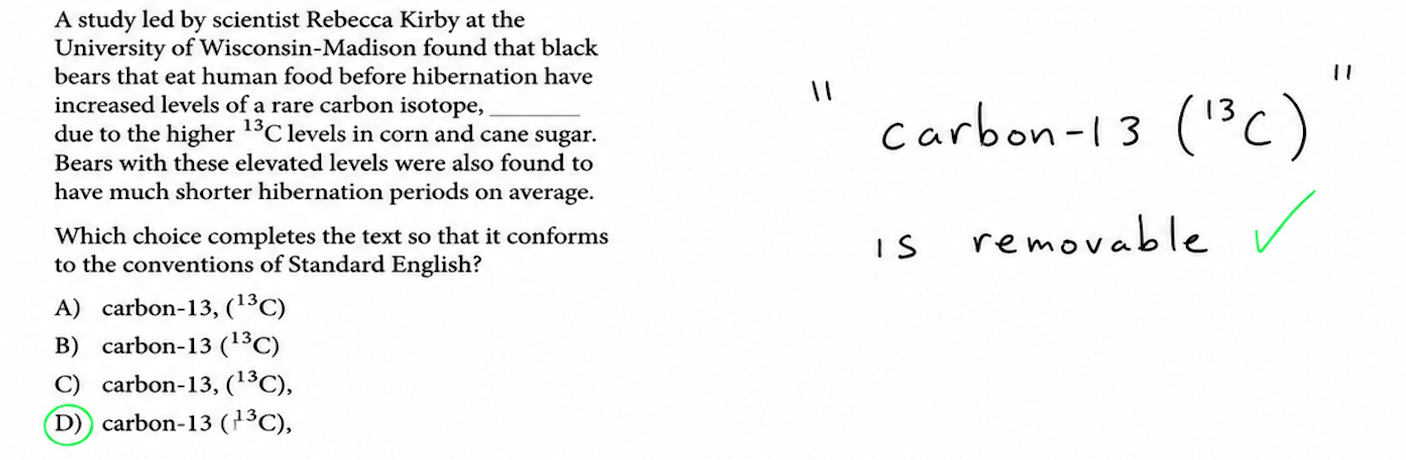
Here's two more examples that work the exact same way.
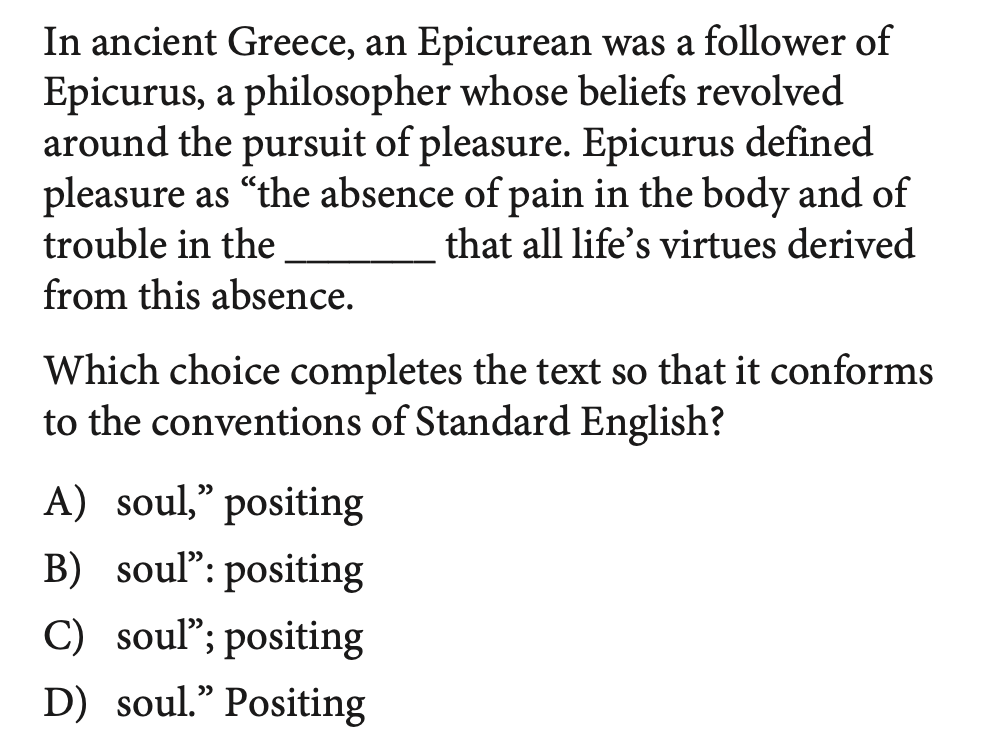
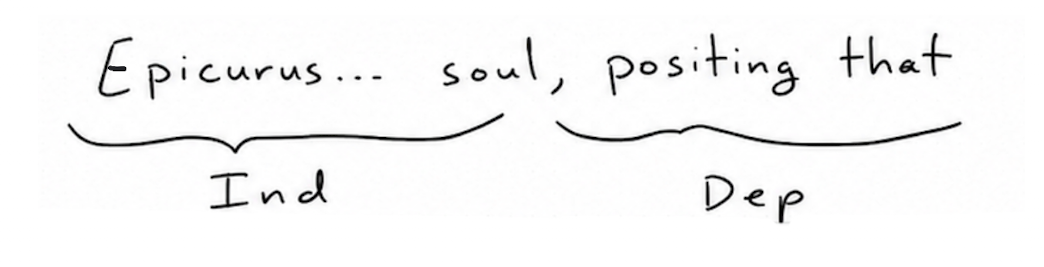
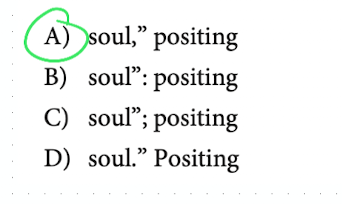
Let's check out an example of the second way the SAT tests comma usage: separating Independent and Dependent clauses. Notice that with C) and D) we do not have a required complete starting from "positing", and in D) we do not have an example or explanation (though it is close). Notice that phrase starts with an "ing" word, "positing"? A common type of dependent clause. And "Epicurus…soul" works as an Independent. Choice A it is.
Rarer, but predictable
Dashes
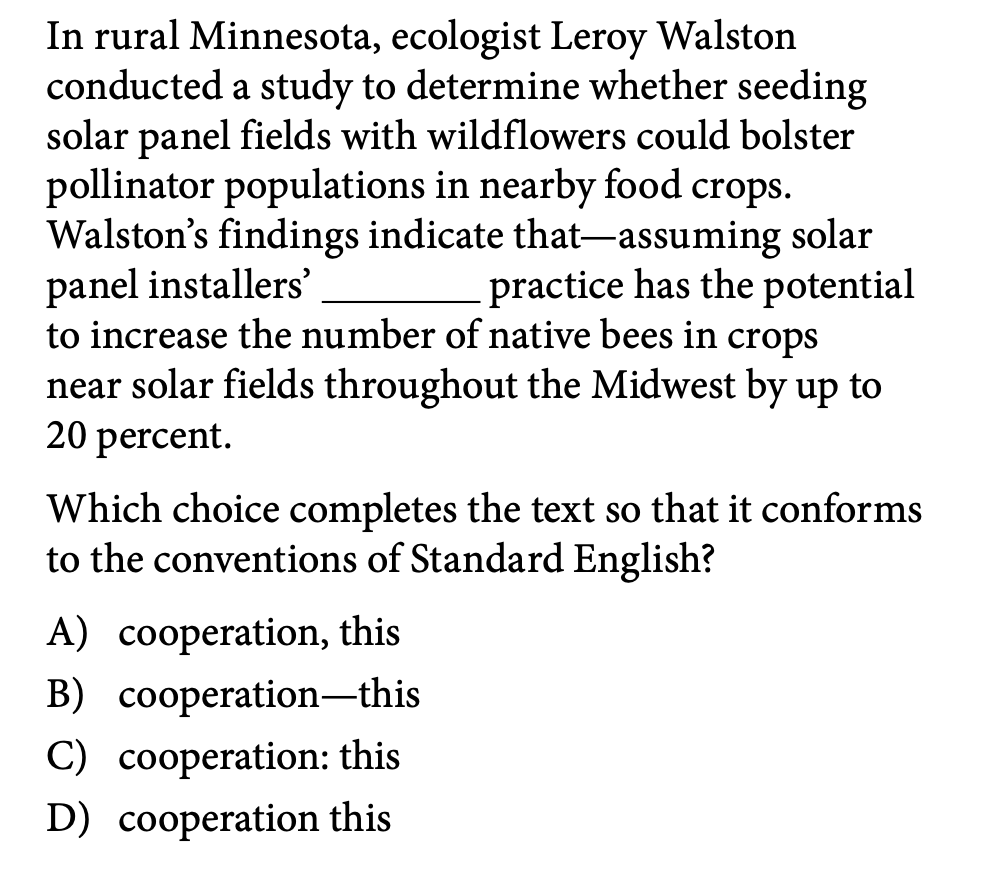
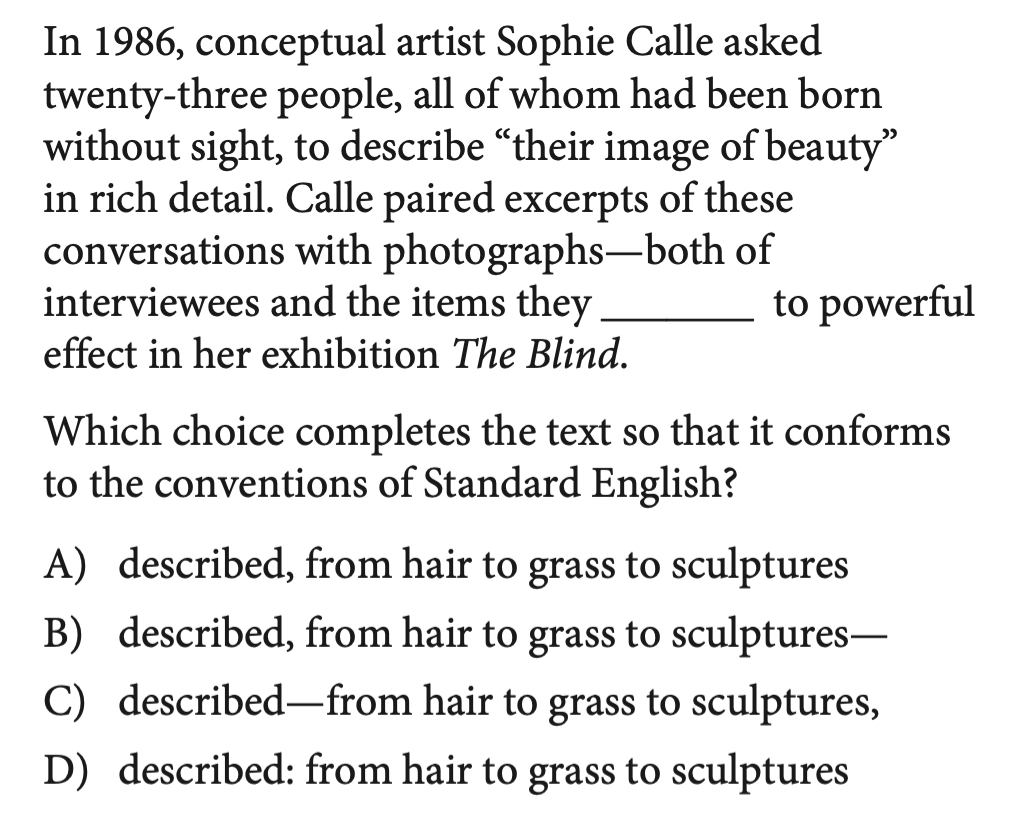
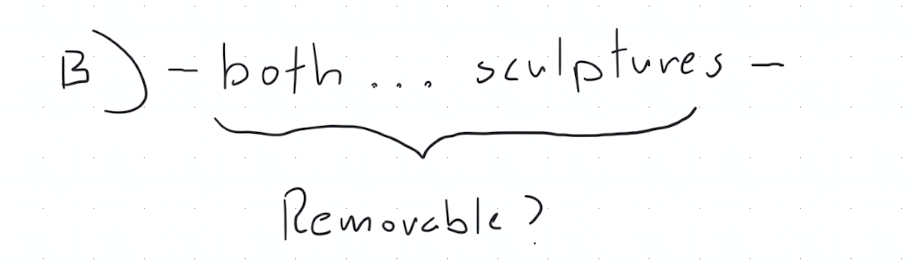
Dashes are tested the exact same ways as the two comma rules we just went over, though they are far less common on the SAT. A sentence can have only 0, 1, or 2 in a sentence. If you have one, it MUST be to separate Independent and Dependent clause. If you have two, they MUST be to bookend interjections. They rarely ask about Ind. and Dep clauses.
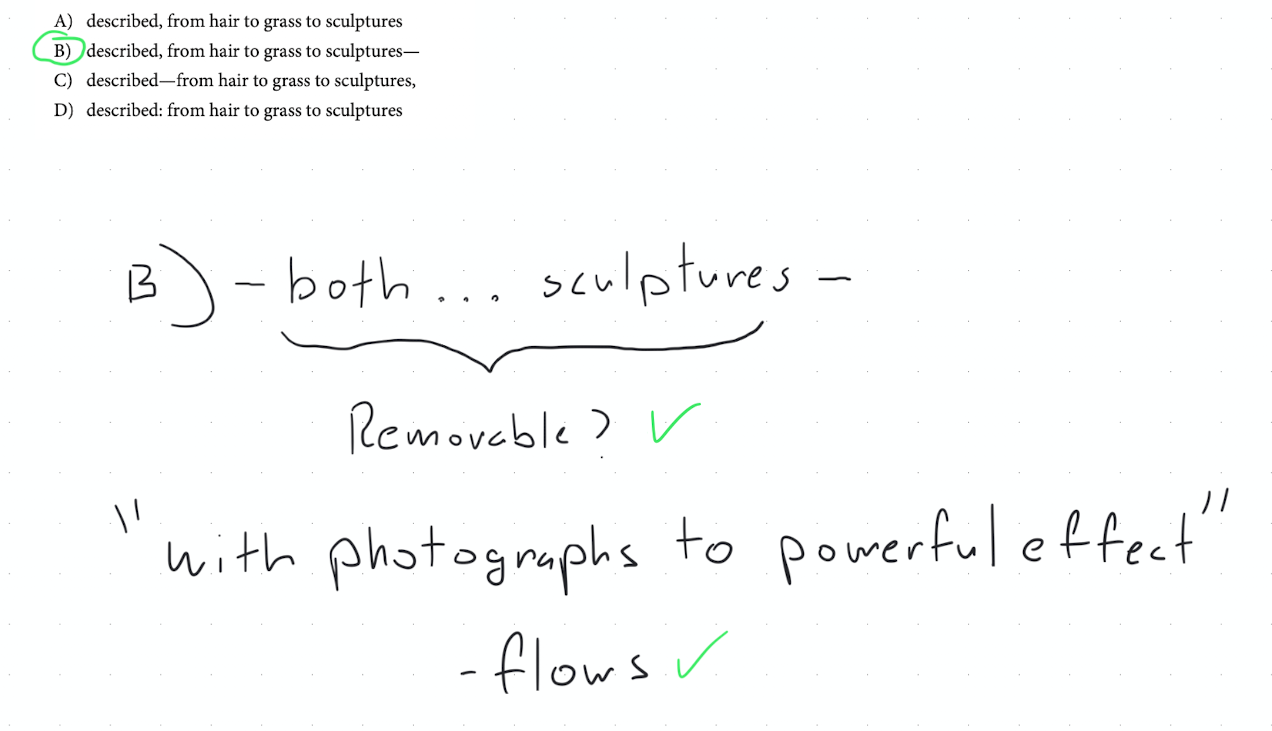
Here's an example. Notice there's already a dash in the sentence? A pretty big indicator we should test choice B. Read the sentence without the phrase "assuming solar panel installers' cooperation" and we see it flows. Choice B it is.

Another example that works the same way.
Looks like a comma question — isn't
Title/Occupation + Name
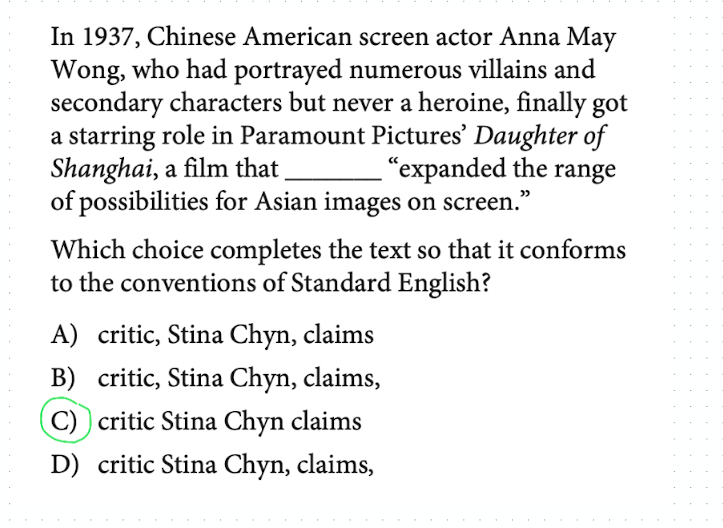
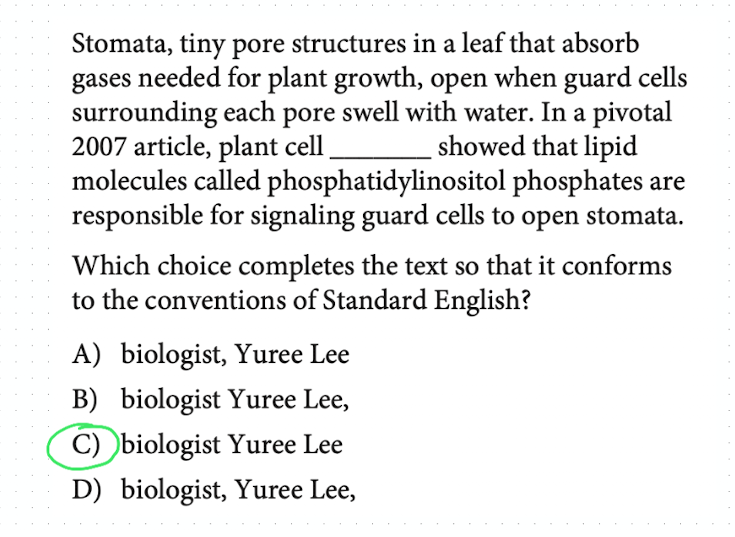
There are their own type of question. Though it looks like it's testing comma usage, you should handle it differently. The name of the question-type tells you exactly what it is: when you see a title/occupation right before a name. "SAT tutor Majid Hasan", "theoretical physicist Robert J. Oppenheimer", "cartoon character Krusty the Clown", etc.
The vast majority of the time, no commas before or after the name.
Check out two examples.
The exception: every once in a while, you'll need a comma after the name (never before) if there's an interjection right after the name (or maybe a dependant clause). "The book was written by legendary journalist Bob Woodward, who won a Pulitzer prize the following year." Here we'd need a comma after the name to separate the independent and dependent clauses.
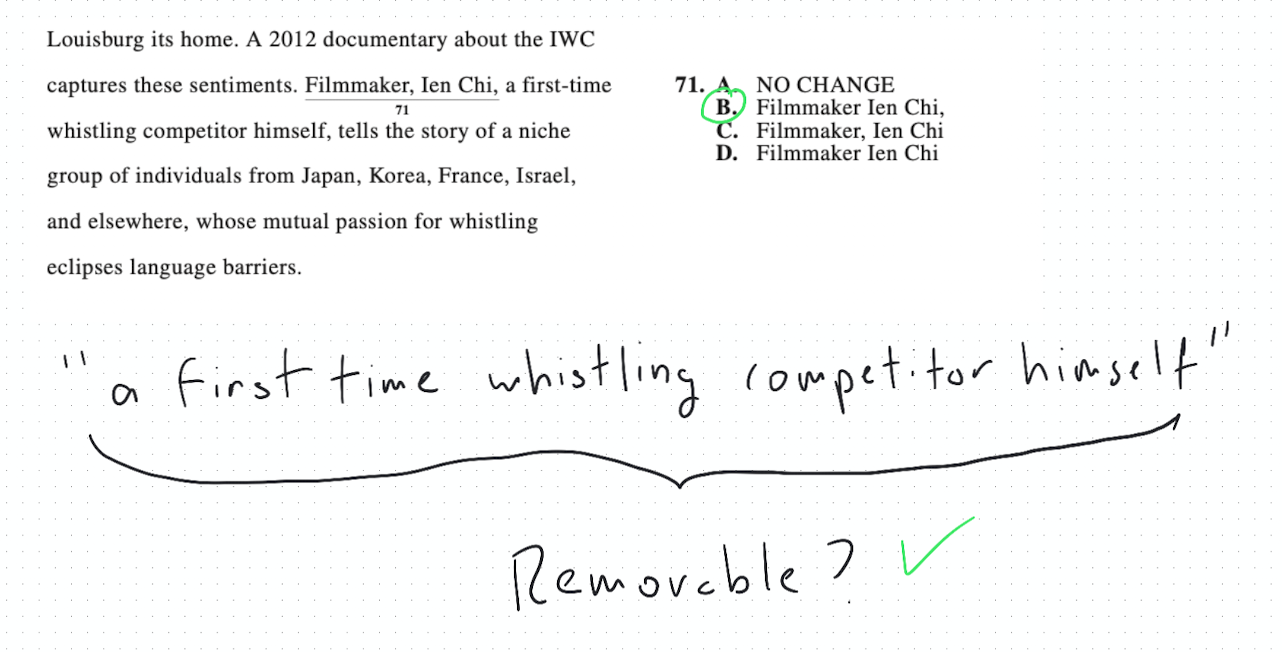
Here's an example of an interjection after the name (it's from the ACT, but it's exactly what you might see on the SAT). See the interjection that starts right after "Ien Chi"? So no comma before the name, but we need one right after.
Rare, but worth knowing
Niche (infrequent) Question Types
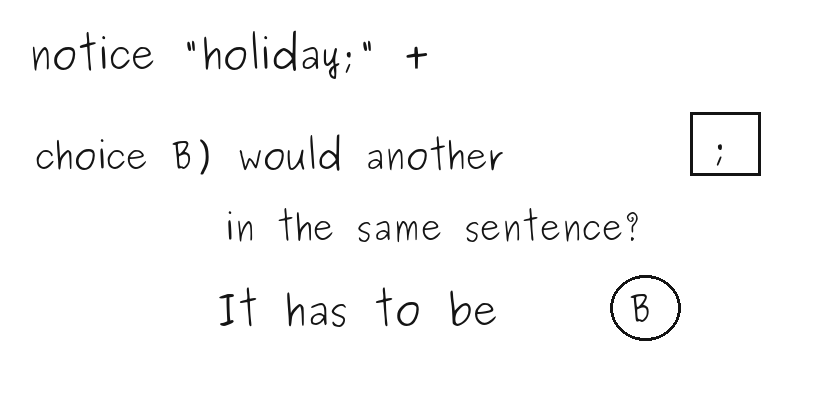
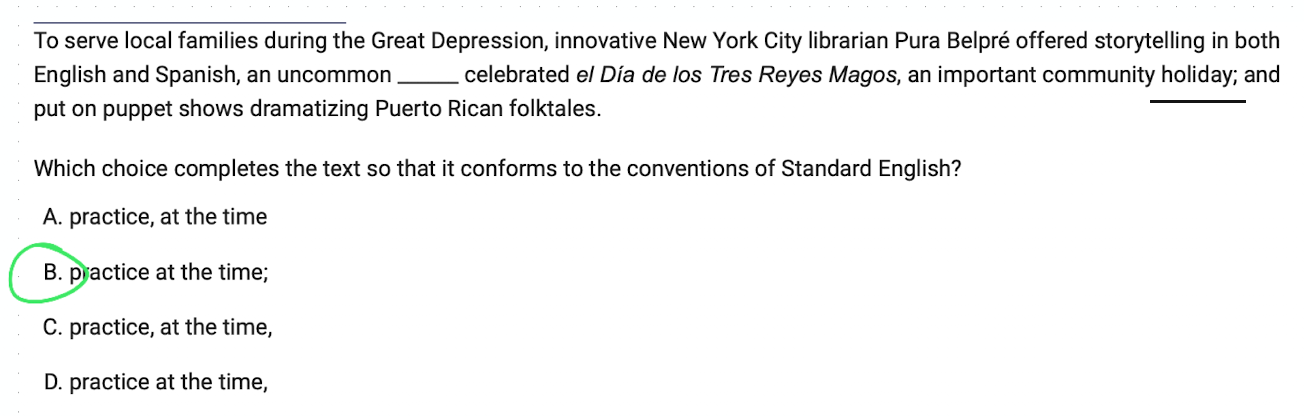
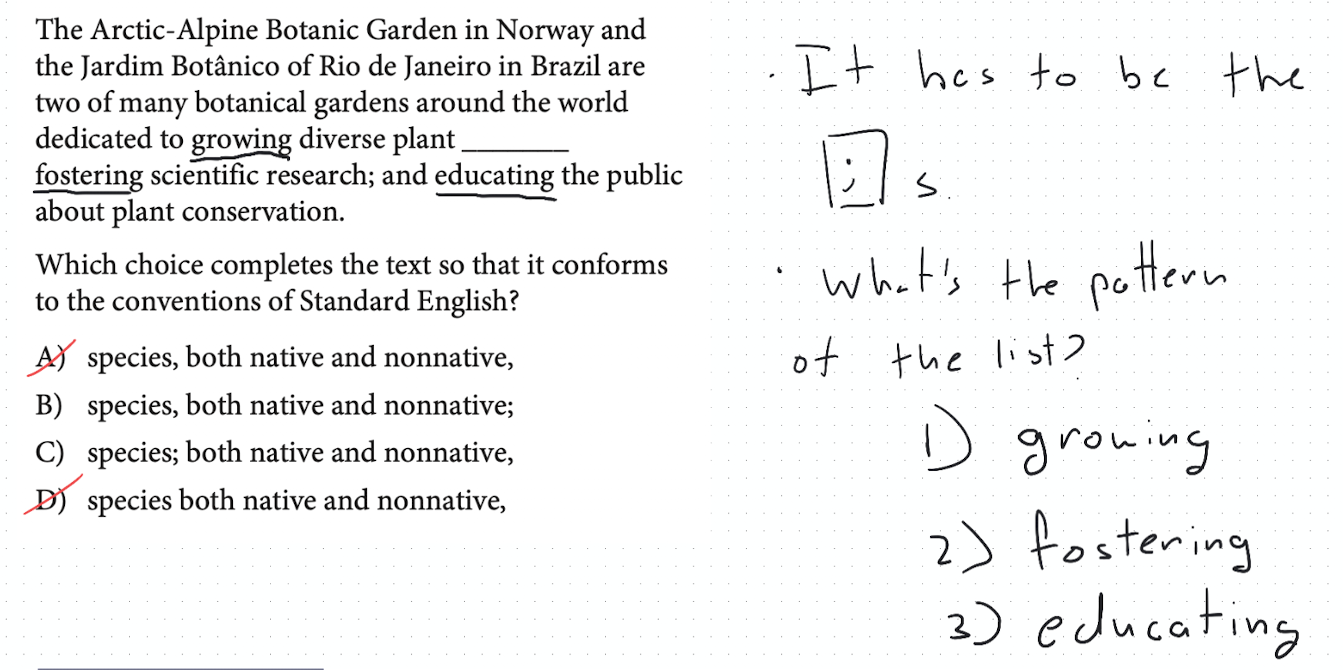
Multiple semicolons. If you see the option to have 2 semicolons in a sentence, meaning there's one in the sentence already and the answers would let you add another, it has to be a semicolon answer choice. Sometimes that's enough to answer the question, but if you have to choose, you need to follow the pattern in the sentence. See, the semicolons are being used like commas in a list.
In this first example, it has be to B) since that's the only option that would have two semicolons in the sentence.
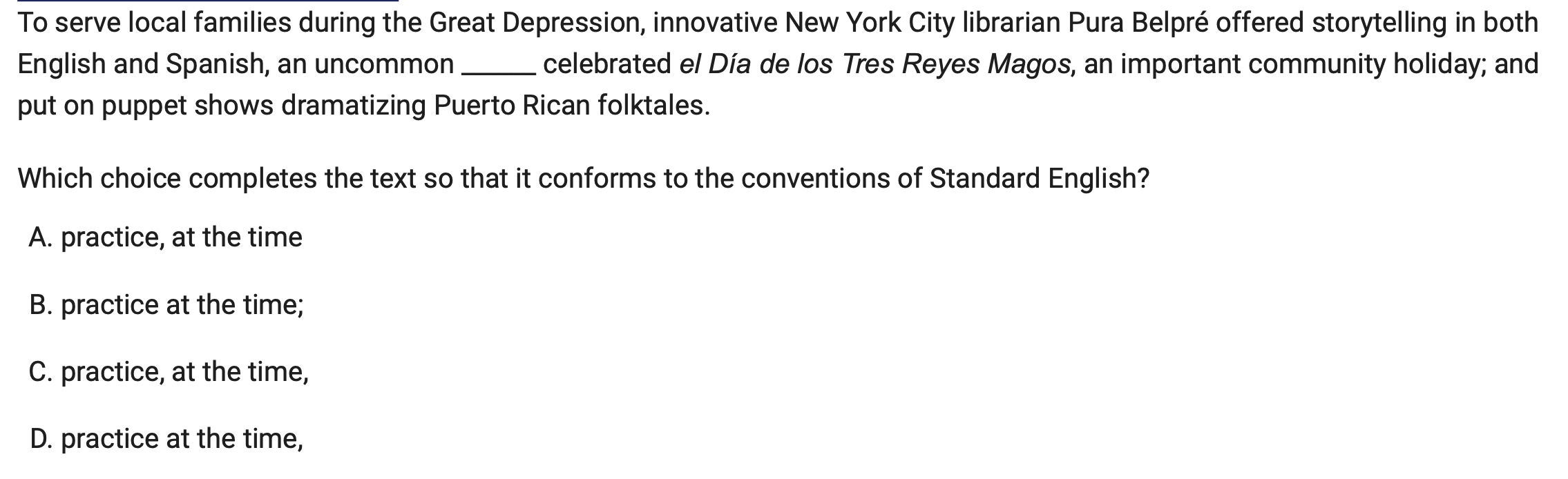
In this second example, we have two options that would result in two semicolons. Therefore, we need to follow the pattern: "…dedicated; …fostering; and educating…"
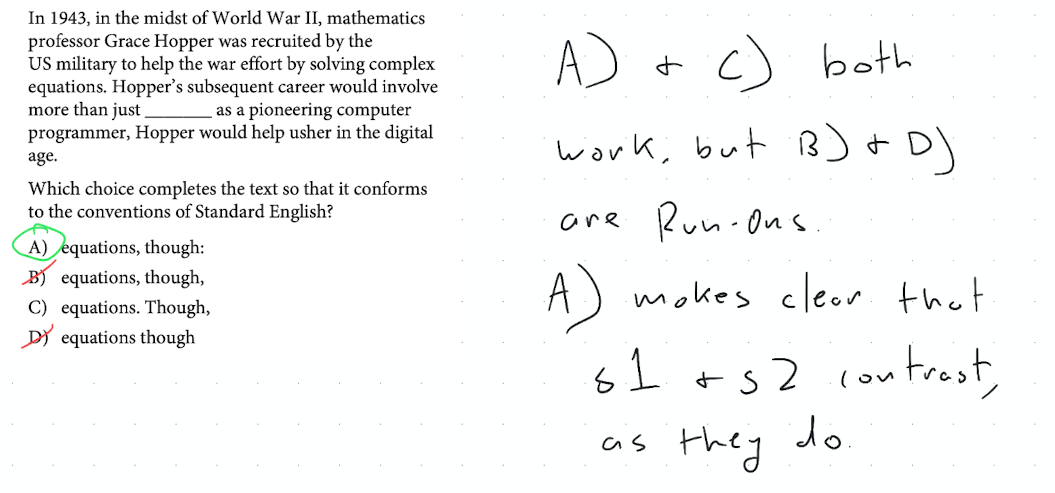
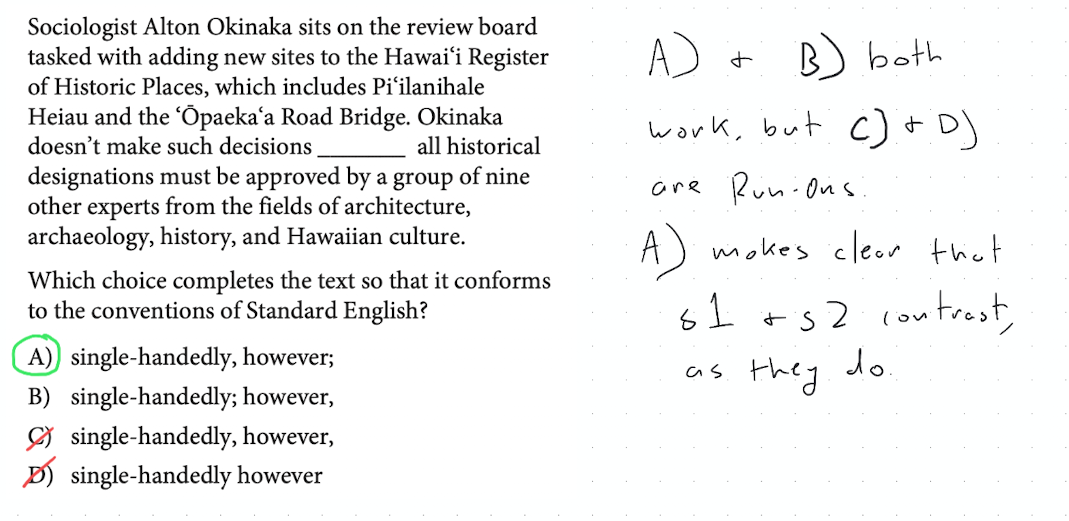
Two correct comp/comp answers (transitions). These questions will have two answer choices that are grammatically correct. They'll correctly link two completes. The question is really about which answer choice presents the transition word correctly. Think of them as having three statements. S1, S2, and S3. The question is whether S1 and S2 contrast, or whether S2 and S3 contrast. So far, it's always been S1 and S2.
Notice that answer choice C) would imply that the idea that her subsequent career was more than just solving equations with the idea that she helped usher in the digital age? Rather, it should be that the idea that she solved equations in the war contrasts with the idea that the rest of her career was about more than just equations. Choice A makes this clear.
This example is the same: Choice A) indicates Okinaka sits on the review board, but that he doesn't make decisions on his own. Choice B) would imply that him not making decisions alone contrasts with the notion that all decisions are made collectively by a group of experts, which doesn't make sense.
Want help putting this into practice?
These patterns click fastest with real SAT questions and someone to check your reasoning. I'm happy to walk through a few together.